
The free manufacturing TMS
Warp TMS gives a manufacturing freight desk its system of record: inbound materials, outbound finished goods, and plant transfers on one board, priced from your contracted rate sheets, audited invoice by invoice, at $0 with no seat limits or load caps.
 By Troy Lester, Co-Founder & CRO
$0 software fees · Rate sheets read, never invented · PO consolidation · Invoice audit · LTL + FTL
Live all-inclusive rates
Is there a free TMS for manufacturers?
Yes. Warp TMS is a free manufacturing TMS: quote and book inbound materials and outbound finished goods across LTL and FTL, load your contracted carrier rate sheets, consolidate purchase orders into full trucks, and audit every freight invoice against its quote, at $0 with no seat limits or load caps.
Can a TMS consolidate purchase orders into one truck?
Yes. Warp TMS consolidates multiple purchase orders into one correctly priced truck: select the POs arriving or shipping together and the consolidation engine does the math before you book. For manufacturers taking steady supplier inbound, that regularly turns three underfilled trucks into one.
How does a manufacturer audit freight invoices against quotes?
With charge level comparison in a TMS: every carrier invoice lines up against its original quote, duplicate PRO numbers get flagged, new accessorials that were never quoted get caught, and org overcharge thresholds turn leaks into exceptions. Warp TMS includes this audit at $0, with QuickBooks CSV export.
Warp customers






Inbound, outbound, and the lanes between plants
Manufacturing freight is three operations wearing one budget: materials in, finished goods out, and the transfers holding the schedule together.
A production plan is only as reliable as the freight feeding it, and most manufacturing freight desks still run that responsibility across a whiteboard, a rate binder, and someone's inbox. Warp TMS puts the three flows on one board. Inbound raw materials get quoted, booked, and tracked before they surprise the receiving dock. Outbound finished goods and plant transfers run on the same routing policy instead of whoever quoted last. And because the boards are carrier agnostic, freight your suppliers or customers book still gets recorded, tracked by milestone, and audited, so the spend picture is complete even when the booking wasn't yours.
What a manufacturing freight desk gets at $0
Six jobs cover the manufacturing freight desk. Every one ships today in Warp TMS, works on freight from any carrier, and costs nothing at any plant count.
Rate sheets
Your contracts, priced automatically.
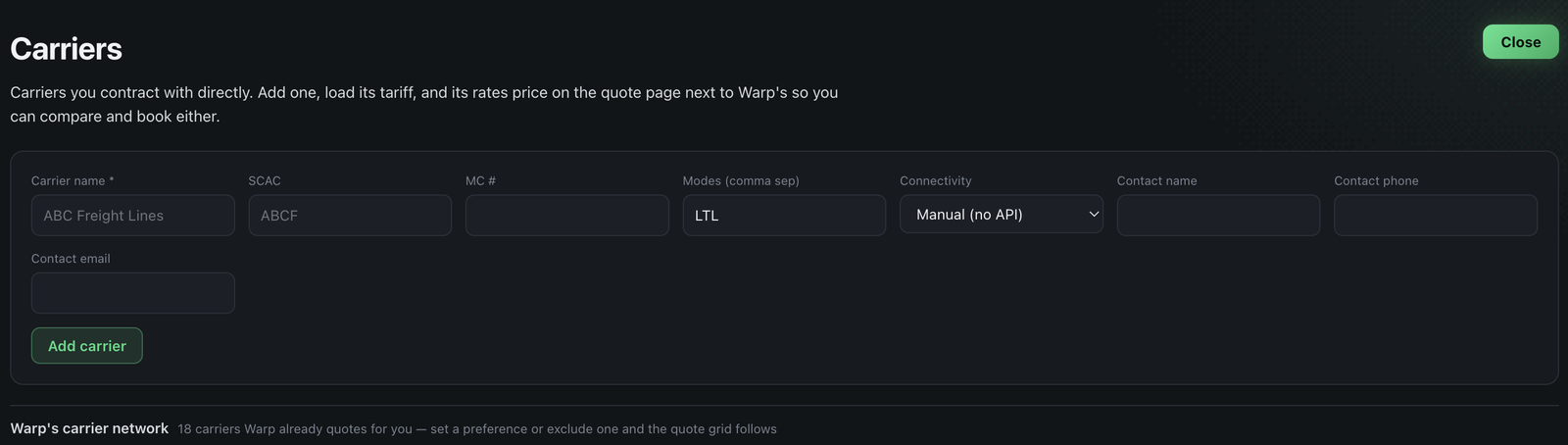
Load contracted carrier rate sheets with human approval before anything writes: the system reads the rate sheet and never invents a price. Every lane then prices from your real contracts.
Inbound
Raw materials, off the whiteboard.
Quote and book inbound LTL and FTL from suppliers, or record freight a supplier booked, so receiving knows what arrives before the truck is in the yard.
Consolidate
Many POs, one truck.
Select the purchase orders arriving together and get one correctly priced truck instead of three underfilled ones. The consolidation math runs before you book.
Outbound
Finished goods and transfers.
Plant to DC, DC to DC, and customer shipments run on the same board as inbound, with the routing policy you set: cheapest, fastest, or preferred.
Audit
Every invoice vs its quote.
Charge level comparison, duplicate PRO detection, new accessorial flags, and org overcharge thresholds, with QuickBooks CSV export for the plant controller.
Report
Service by lane and facility.
On time pickup and delivery, transit, volume, spend, and service failures by carrier, market, lane, mode, and day. XLSX and CSV export for the ops review.
EDI, ERP, and the honest boundary
Some manufacturers have EDI mandates from customers or an ERP that must stay the system of record. Warp TMS is honest about both.
Warp TMS does not do EDI, and it doesn't ship ERP connectors.
If a trading partner mandates EDI, that requirement points you at paid enterprise platforms, where implementations run $100K to $500K over 6 to 12 months (as of August 2026, per published implementation guides across the category), and the spend is simply the cost of the mandate.
What Warp TMS does ship is the integration stack most plants actually use: CSV order import, a public read and write API with org keys, and signed webhooks (HMAC SHA256) so your ERP or MES can hear about freight events without polling.
The comparison logic lives in free TMS vs paid TMS, written to be equally honest in both directions.
Need to move manufacturing freight, not manage it?
This page is about the free software. The freight service for manufacturers is its own operation, and it has its own page.
If the job today is moving materials or finished goods rather than adopting software, Warp's manufacturing freight page covers the service side: inbound supplier programs, recurring facility transfers, and outbound distribution through the Warp network, with live GPS on Warp hauled loads and scan events at every cross-dock.
The TMS and the network are separable on purpose: run the software with your own carriers and never book Warp, or run Warp freight without adopting the TMS.
Plants that use both get one more convenience, since some exception types resolve automatically when the TMS is attached to the network moving the freight.
Frequently asked questions
Can Warp TMS load our contracted carrier rate sheets?
Yes. Carrier rate sheet ingestion reads your contracted rates into the quote grid with human approval before anything writes: the system reads the rate sheet and never invents a price.
Your negotiated numbers then price every lane automatically, beside marketplace rates and Warp's own bookable rate.
Does Warp TMS track freight from our own carriers?
Freight booked through Warp tracks live with hourly sync.
Freight with your own carriers is recorded on the same board and tracks by milestone entry, which is the honest version of visibility without a telematics integration.
Either way, one board answers where every load is.
Can plant and DC teams share one Warp TMS org?
Yes. Six roles with a capability matrix control who quotes, books, and approves across facilities, backed by an org audit log, encrypted carrier credentials, and multi tenant row level security.
Invite every plant by email; the seat count never touches a price.
About the Warp freight network
More about the Warp freight network
Warp is a technology-driven freight network that combines cargo van, box truck, LTL, and FTL capacity under one operating system. Shippers get instant rates, real-time tracking, and access to 70+ cross-dock facilities and 14,000+ cargo vans and box trucks — with 80%+ US LTL zip-to-zip coverage and nationwide FTL, box truck, and cargo van.
The network is supported by 24,000+ vetted FTL carriers.
Unlike traditional brokers, Warp uses AI to match the right vehicle to every load based on weight, dimensions, urgency, and cost targets. Cross-dock operations reduce transit time by eliminating unnecessary terminal transfers.
Pool distribution and zone-skipping programs help enterprise shippers lower per-unit delivery costs while maintaining tight appointment windows.
Self-serve shippers can quote, compare, and book freight online in under two minutes. Enterprise accounts get dedicated capacity planning, committed rate programs, and a named operations team. Every shipment includes scan-level visibility from pickup through final delivery.
Warp operates across the contiguous United States with regional density in the Southeast, Texas, Midwest, and Northeast corridors, and West Coast and Southwest coverage from Los Angeles, Seattle and Phoenix.
Warp operates 70+ cross-dock facilities across the US, with named markets including Chicago, Atlanta, Houston, New York, Savannah, Orlando, Charlotte, Indianapolis, Columbus, Denver, New Orleans, Milwaukee, Dallas-Fort Worth, Nashville, Phoenix, Tampa Bay, Seattle, Los Angeles. They support faster transfers and fewer touches on recurring lanes.
Freight modes and vehicle types
| Mode | Max payload | Max cube | Best for |
|---|---|---|---|
| Cargo van | 3,500 lbs | 400 cu ft | Time-sensitive, last-mile, light pallets |
| Box truck | 10,000 lbs | 1,500 cu ft | Regional distribution, no dock required |
| LTL | Per-pallet | Shared trailer | Lower per-pallet cost via cross-dock routing |
| Dry van / FTL | 42,000+ lbs | Full 53-ft trailer | High-volume lanes, recurring programs |
Cargo vans handle loads up to 3,500 pounds and 400 cubic feet, ideal for time-sensitive deliveries, last-mile retail replenishment, and lightweight palletized freight.
Box trucks carry up to 10,000 pounds and 1,500 cubic feet, fitting most regional distribution and store delivery needs without requiring a loading dock.
Dry vans and full truckloads move 42,000+ pounds for high-volume lanes and recurring programs. LTL shipments share trailer space on optimized routes through Warp cross-docks, reducing per-pallet cost by consolidating multiple shippers on the same vehicle.
Warp does not default every shipment to a 53-foot trailer. The AI engine evaluates load weight, cube, delivery window, and cost to recommend the right vehicle. Shippers see all available mode options with live pricing in one comparison screen before booking.
Cross-dock operations
Cross-docking at Warp facilities keeps freight moving instead of storing it: inbound freight is sorted and transferred directly to outbound vehicles, typically within hours. When inventory does need to sit, Warp's fulfillment centers in Los Angeles, Dallas, Chicago and New Jersey hold it inside the same network, with same day delivery within 30 miles of each.
This reduces dwell time, lowers damage risk, and compresses delivery windows. Warp cross-docks support pallet-in, pallet-out operations with scan-level tracking at every handoff point.
- Atlanta — Southeast retail flow
- Chicago — Midwest manufacturing and replenishment
- Houston — Texas industrial distribution
- New York — dense Northeast delivery
Facility locations are selected for corridor density: Atlanta handles Southeast retail flow, Chicago serves Midwest manufacturing and replenishment, Houston covers Texas industrial distribution, and New York supports dense Northeast delivery. Each facility operates on appointment-based scheduling to prevent congestion and maintain throughput consistency.
Enterprise freight programs
Enterprise shippers get committed rate programs, dedicated account management, and custom SLA design. Warp builds lane-by-lane rate structures that account for volume commitments, seasonal variation, and mode flexibility. Operations teams monitor shipment execution daily and intervene proactively when exceptions occur.
Self-serve freight quoting
Shippers enter origin and destination, load details, and delivery requirements to see live rates across all available modes. Quotes include estimated transit time, vehicle type, and total cost.
Booking takes one click. After booking, shippers track every shipment with real-time GPS location, milestone updates, and proof of delivery documentation.
Industries and use cases
Retail shippers use Warp for store replenishment programs that deliver to hundreds of locations per week on tight appointment windows. Apparel brands use zone skipping to bypass regional parcel sortation and reduce per-unit delivery cost.
Food and beverage companies rely on time-definite delivery for perishable goods. Manufacturing operations use Warp for inbound vendor consolidation, combining multiple supplier shipments into fewer, fuller loads through cross-dock facilities.
Distribution companies use pool distribution to serve multiple delivery points from a single origin, splitting full truckloads at cross-docks into smaller last-mile vehicles.
Urgent freight recovery covers emergency capacity needs when primary carriers fail or demand spikes unexpectedly. Middle-mile optimization reduces cost and transit time on the longest segment of multi-leg shipments.
The production plan deserves freight it can trust.
Create your free account at warptms.com, load a rate sheet, and run next week's inbound through a real system. If Warp's rate wins a lane, book it; if your carrier wins, tender there. The software costs nothing either way.
$0 software fees · Rate sheets read, never invented · PO consolidation · Invoice audit · LTL + FTL
Performance figures are computed from Warp network data. See our methodology.
By Troy Lester