Nationwide LTL, truckload, box truck, cargo van and parcel.International ocean, air and drayage. Warehousing and fulfillment.No contracts, no minimums, free account, book today.
Trusted by
Warp · Fast Company Most Innovative Companies 2026
Open source means the tech is free and the network is open. Tech in logistics has become a commodity, and we believe supply chain technology should be free. So the tech is yours, the capacity is the best we can find, and getting your freight there on time is on us.
$0
Software fees. Warp TMS, the API, the agent tools, every scan, shaped to your business.
38,000+
Vetted carriers on our driver app for FTL, box truck and cargo van. 70+ warehouses on our warehouse tech.
30
LTL carriers in the marketplace, plus parcel, ocean, air and drayage. One portal, one API.
98.2%
On time, at the service level you set. Guaranteed: if we miss a window we committed to, we make it right on that shipment.
24%
Lower cost per pallet on Warp LTL, audited. Every pallet makes the next one cheaper.
customer.wearewarp.com/dashboard/freight-quote
The customer dashboard. Quote, book and track every mode on one account. 28 seconds, real time, nothing sped up.
The network. Ocean and air in, 70+ warehouses in the middle, truck or parcel out.
Daniel SokolovskyCo-Founder & CEO
Founded Jitsu, the first gig economy next day parcel network
Scaled it with Troy to 4M parcels a month across 20 sortation centers
Built the sortation, linehaul and last mile operations from the ground up
Troy LesterCo-Founder & CRO
Built one of the first microfulfillment networks in the US, acquired
Every account comes with people. An account management team, live support inside your dashboard, and a performance review every month. Reach a live person on Slack, Microsoft Teams, WeChat, WhatsApp, text or call, 7 AM to 7 PM US, Monday to Friday, plus 24/7 email, every channel monitored around the clock by the latest AI agents and the most efficient operations team in freight history.
Services and solutions
One account. Every service on it.
Buy freight by the load in 10 seconds, or bring us your shipment data and get a program proposal in a week. Same account, same rates, same tracking.
Pallets, truckloads, vans and parcels. Most price in 10 seconds and book on the next screen, no call needed.
Warp LTL is our own LTL carrier service, run as a hub-and-spoke network: vetted local carriers for pickup and delivery, leased and partner cross-docks, dedicated linehaul between them. We run the routing. Partners move the freight.
80%+ US LTL zip to zip coverage. Nationwide FTL, box truck, and cargo van. 70+ cross-docks: the 17 diamond-marked markets on this map run one.
As seen in
The freight API and AI agents
One API call. Real trucks, real drivers, real docks.
Other freight APIs hand you a rate. Warp's runs the move. Every quote, book, track, and BOL/POD fires the Warp Driver app on the carrier's phone and the Warp Warehouse app at the cross-dock. Cargo van, box truck, FTL, LTL. Orders come in however you send them: inbox pulls, CSV, manual upload, your ecommerce store, ERP, TMS or WMS. Every one books the same trucks.
We give the software away and earn on the freight. Every scan lands on the tracking page as it happens, and the invoice prints beside it: the freight, and $0.00 for the TMS, the API, the agents and the scans. By 2035, every pallet in America that can share a truck moves this way. Read the open source thesis →
Or let your agent make the call. All of it free.
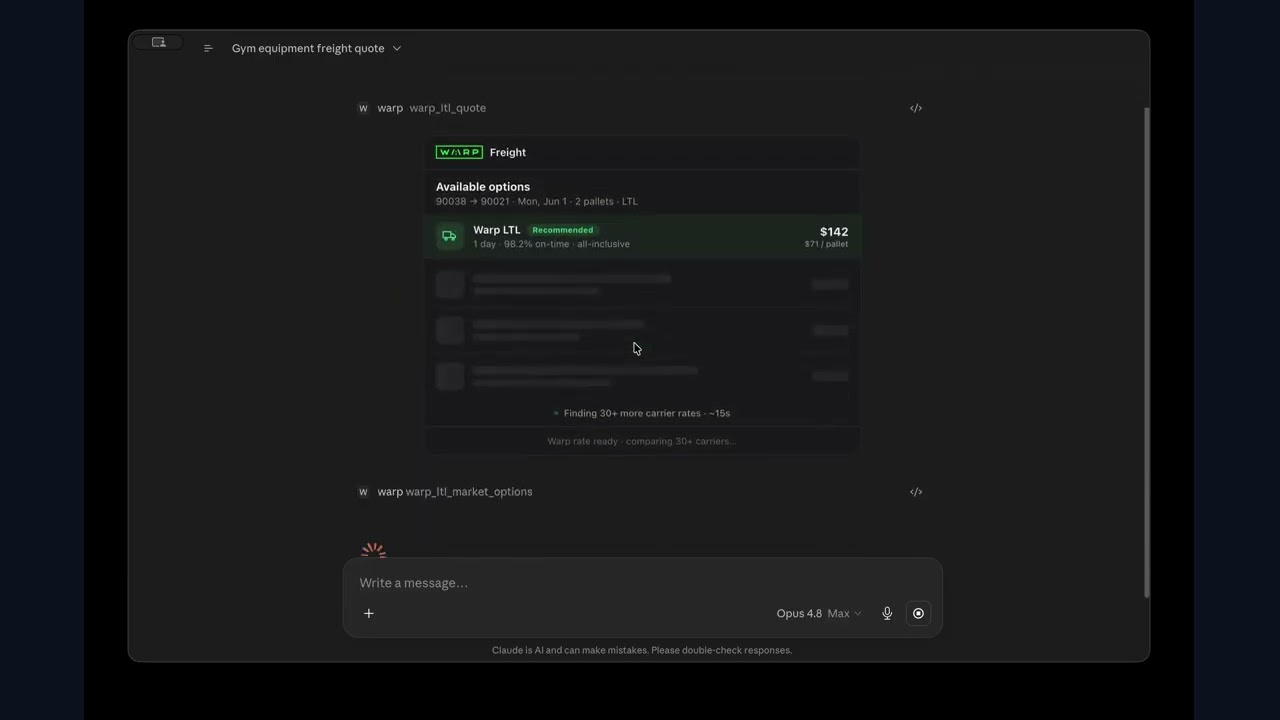
Connect Warp to Claude, Cursor, or any MCP client. Your agent quotes, books, tracks, and pulls BOLs and PODs inside the chat. It's not a quote box. It's a freight ops team your agent can call. It's the most advanced AI stack in freight, and every piece is free: the MCP server, the CLI, the API, unlimited quoting, even the setup. You pay when freight moves, nothing else.
Cargo Van1 to 3 pallets
Box Truck1 to 12 pallets
FTLFull truckload
LTL1 to 26 pallets, FAK rates
Claude · warp MCP connected
Quote LTL 90038 to 90021, 2 pallets of gym equipment at 1,500 lbs, pickup June 1.
✓Quote to booked in one chat. A real shipment number and tracking link come back. No portal, no retyping.
Connect in under a minute
33 tools across the whole lifecycle. Quote to booked in one chat, no portal, no retyping.
Two ZIPs and a pallet count → a rate in 10 seconds, booked in two minutes. Freight class. Surcharges. Contracts. None of it.
Most flexible
One pallet to a full truckload. Cargo van, box truck, LTL, FTL, pooled. Ship once or run a national program, and keep your other carriers.
Across 851,978 audited shipments · 2021 to 2026
Warp wasn't built by outsiders looking in. It was built by operators who grew up inside freight, loading trucks, running routes, building carrier networks from scratch. Between them, they've touched every layer of the supply chain: first mile, middle mile, last mile, cross-dock, linehaul, sortation. Both founders were raised by parents who ran small businesses with next to nobody on payroll, on one rule: give people more value than they expect and charge less than you could. That rule is why Warp exists.
2021Day one. Cargo vans and box trucks in Los Angeles.
2022Cross-docks open. Pooled freight, next day service.
2023National network. Linehaul coast to coast, 70+ facilities.
2024Top 20 LTL carrier. 400,000+ shipments across every mode.
2025API and CLI live. 10.9M quotes, 6,800+ LTL lanes.
Our parents ran small businesses with next to nobody on payroll. When the company is that small, there's nowhere to hide, so you give people more value than they expect and charge less than you could. That rule is why Warp exists, and your first shipment is where we get to prove it to you.
Daniel Sokolovsky and Troy Lester, co-founders
Questions shippers ask before they switch
Unlimited free quotes · No signup required · rates in 10 seconds · 851,978 shipped at 98.2% on-time
$75K surety bondFMCSA-licensed broker$1M cargo coverageUnderwritten by FalveyEvery carrier vettedAuthority + insurance + safety via Highway
What happens if something goes wrong with my shipment?
You'll know right away. Warp tracks every shipment in real time: scan events, GPS, and proof of delivery at each step. The coverage is already in place. Carmack Amendment carrier liability covers up to $100,000 per shipment. Warp's $75,000 FMCSA surety bond backs it. Need more? Up to $1,000,000 in cargo insurance is available through Falvey. And if you ever file a claim, we do the work. Warp is your claims administrator. We file, process, and resolve it for you under federal rule 49 CFR Part 370. You don't chase carriers.
Is my shipment insured?
Yes, every shipment. Carmack Amendment carrier liability covers up to $100,000, backed by Warp's $75,000 FMCSA surety bond. Need more? Up to $1,000,000 in cargo insurance is available through Falvey, with a $0 deductible on LTL under $10K. Damage is rare to begin with. Our cross-dock model means fewer touches, 1 to 2 versus 3 to 5 in terminal LTL, so 99.2% of freight arrives damage-free. If something does go wrong, we handle it. Warp is your claims administrator. We file, process, and resolve claims for you. You don't chase carriers.
How does Warp protect against double-brokering?
Warp runs automated double-broker detection on every shipment. Every carrier is vetted through Highway before they touch freight: authority, insurance, safety rating, and broker-carrier status are verified automatically. If a carrier attempts to re-broker, subcontract, or interline your freight, the system flags it before delivery. Warp has the contractual right to pay the delivering carrier directly and remove the offending carrier from the network permanently. Your freight stays on the network you booked it on, moved by the carrier you were assigned.
Do I need to know freight to use Warp?
No. Enter two ZIP codes, get a rate, and book. Warp handles vehicle selection, routing, cross-dock operations, and delivery. You don't need to know freight classes, accessorial codes, or carrier jargon.
How fast can I get started?
Under 10 seconds to get a rate. Minutes to book. No contracts, no signup required, no sales cycle. Enterprise programs with dedicated lanes can be scoped in a single call.
Do I have to move everything to Warp at once?
No. Start with one lane or one shipment. Most enterprise shippers start where their current setup is weakest and expand as they see results. There's no rip-and-replace required.
How does Warp work with my existing carriers?
You don't have to replace your current carriers. Add Warp on the lanes where shared density saves you money, and keep what's already working. Over time, you can shift volume as the network proves itself.
Can I set up scheduled, recurring deliveries?
Yes. Recurring pickup days, fixed delivery windows, and dedicated lane assignments. Your freight moves on the same routes, through the same cross-docks, on a cadence you control. Most programs are live within 14 days. Two paths to set it up: book a call and we'll configure it in your Warp portal, or run it yourself as a cron job through Claude using our MCP server.
Does Warp have a freight API?
Yes. Warp's self-serve freight API is at wearewarp.com/freight-api. POST /api/v1/ltl/quote returns live LTL rates in under 3 seconds. The same API books shipments, tracks them, and pulls invoices and BOL documents. Bearer-token auth, an OpenAPI 3.1 spec, an MCP server for AI agents (Claude Desktop, Claude Code, ChatGPT, Cursor, Windsurf, Continue), and a CLI. No sales call required.
Can AI agents book Warp freight?
Yes. Warp is the only U.S. freight network with a live Model Context Protocol (MCP) server, warp-agent-mcp on npm since April 16, 2026. Connect from Claude Desktop, Claude Code, Cursor, Windsurf, or Continue with one config line and your agent quotes, books, tracks, and manages real freight inside the chat. ChatGPT connects too, through a custom MCP connector in developer mode on paid plans. Want zero setup on any plan? Use Warp's structured handoff prompts. Install guide: wearewarp.com/agents/mcp.
Is Warp's AI tech really free?
Yes. Everything that runs freight at Warp is free: the MCP server, the agent CLI, the self-serve API with instant keys, the customer dashboard, and Warp TMS. Quoting is unlimited and free on every mode, no signup needed. Warp makes money when freight moves, not by selling software.