
Warp Yard: the yard management system for docks and crossdocks
Run the gate, the yard, the doors, and the dock schedule from one screen. Carriers book their own appointments, drivers check in from their phone, and detention adds itself up. Sign up with a Warp account at warpyardmanagement.com and set up your yard in minutes. Updated October 2026.
 By Troy Lester, Co-Founder & CRO
Gate · Yard map · Doors · Dock schedule · Carrier booking · Driver check in · Detention reports
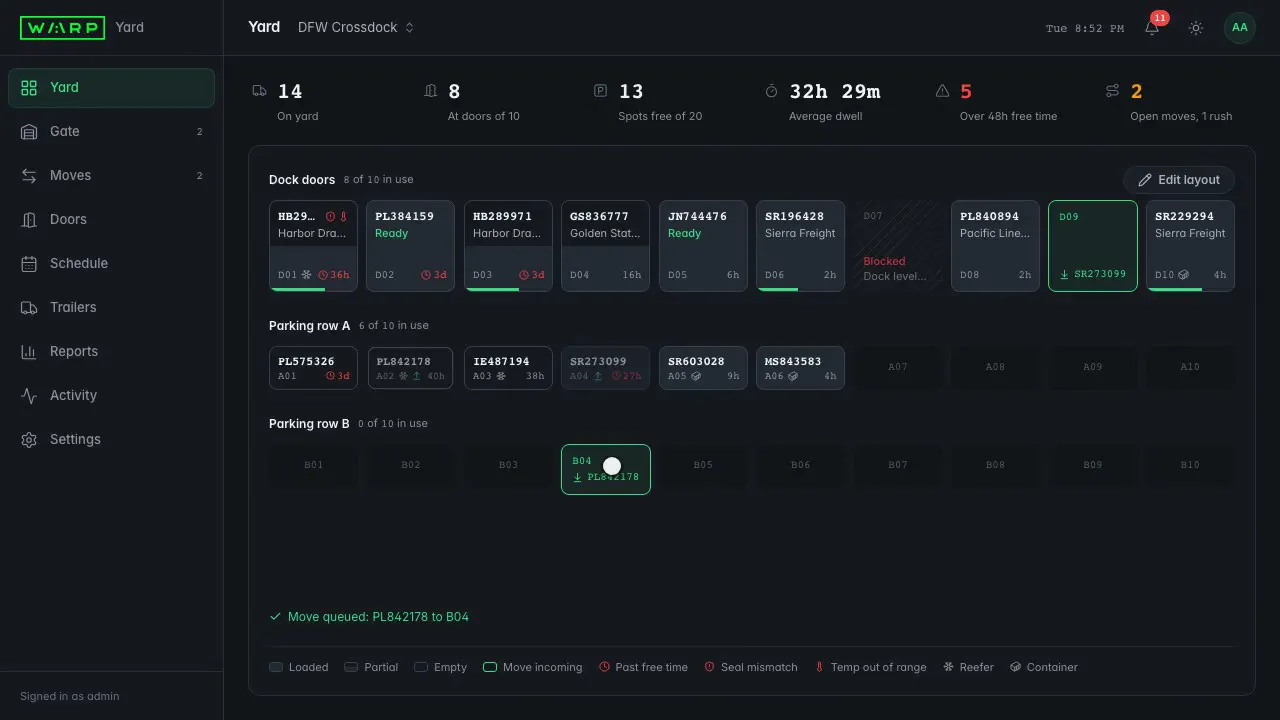
Every trailer on one map.
Doors and parking rows laid out the way your yard is. Drag a trailer to a free door or spot and the move goes to a jockey, with the target held until it lands.
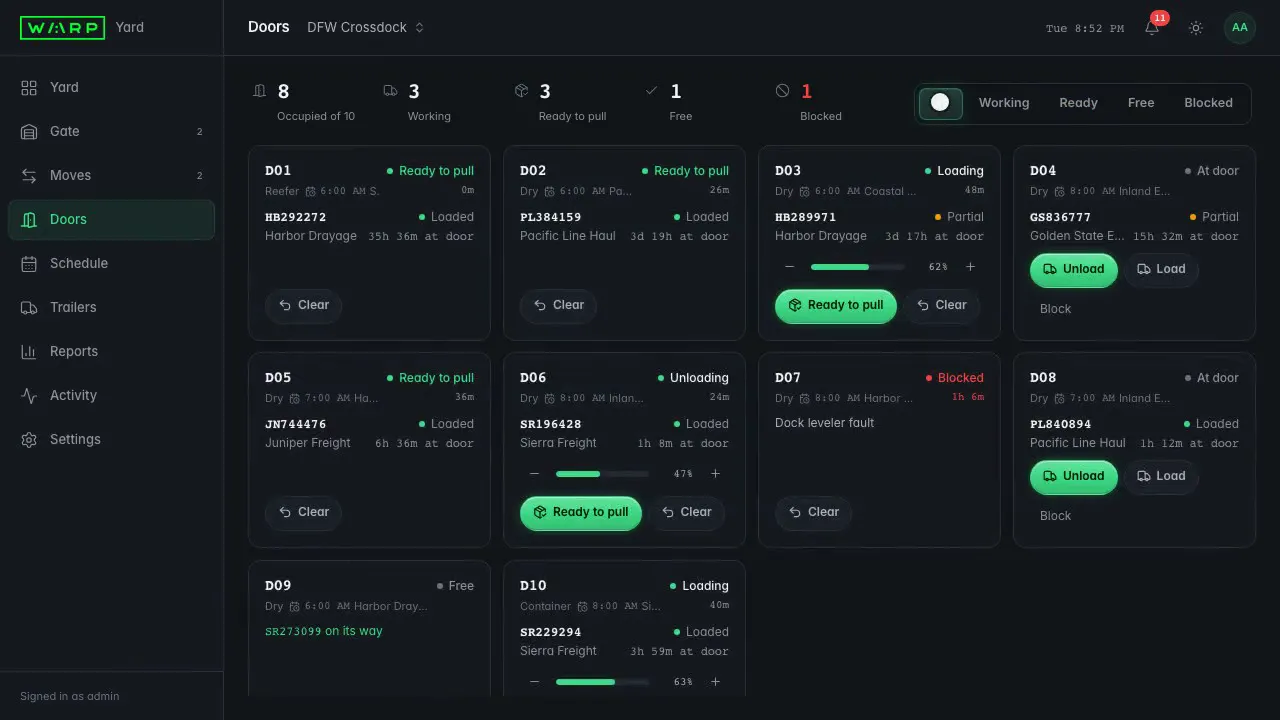
Know which doors are working.
Unloading, loading, ready to pull, or blocked, with progress and time at the door. Mark a trailer done and filter to what needs pulling.
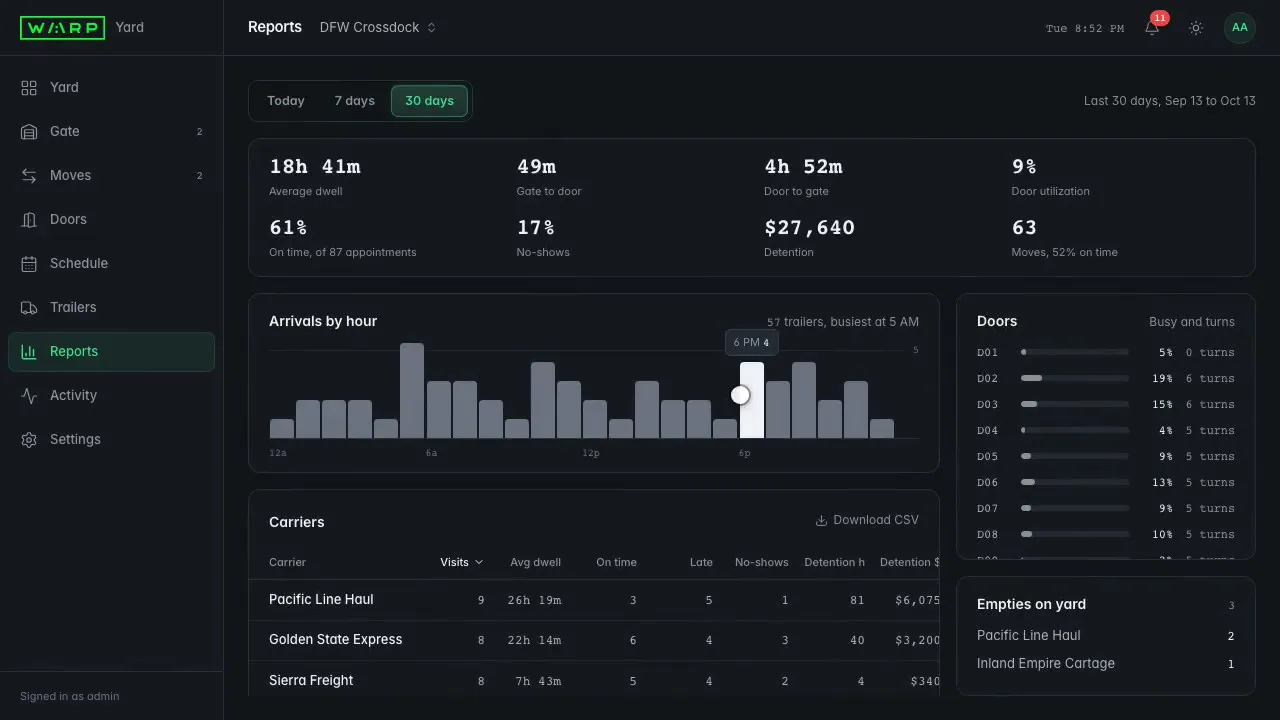
Dwell, detention, and door use.
Average dwell, gate to door, door utilization, on-time appointments, no-shows, and detention dollars by carrier, for today, 7 days, or 30 days.
01Gate
Check a truck in before the driver finishes talking.
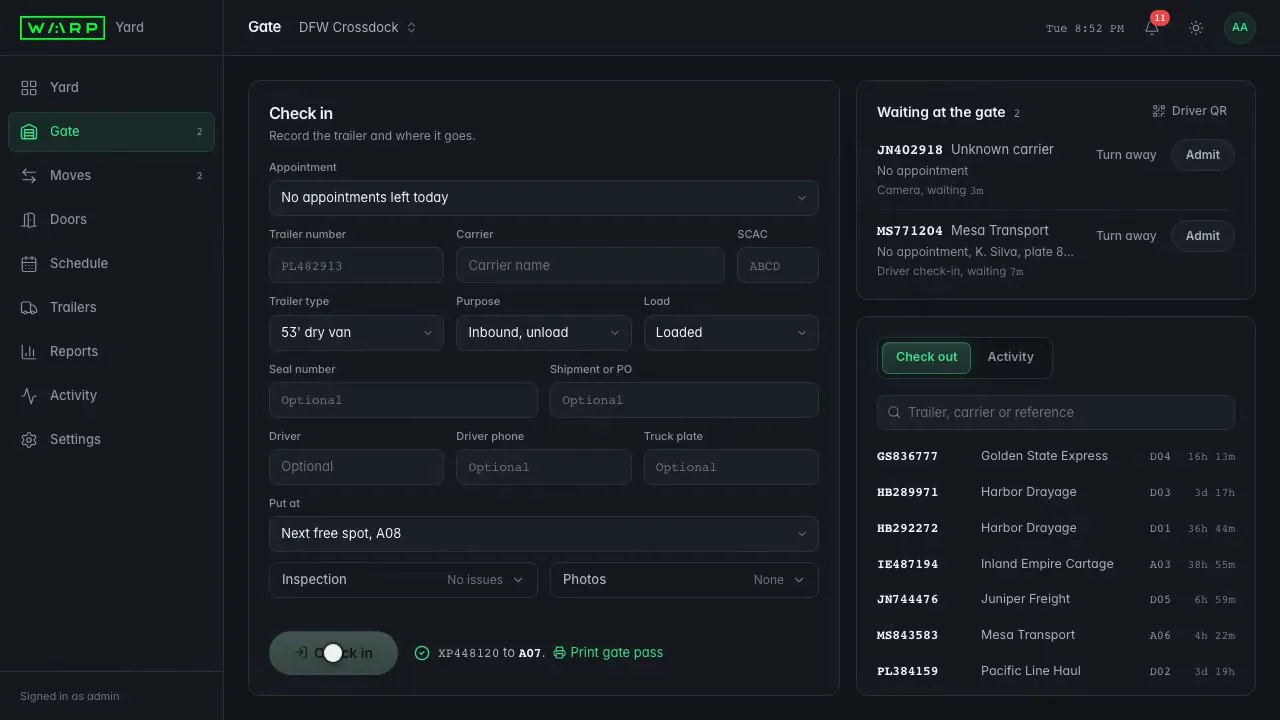
The gate records the trailer, carrier, seal, load, driver, and plate on one screen, picks the door or the next free spot, and prints a gate pass. Appointments for the day are one tap away, so a booked truck fills itself in.
- Seal number checked again at check out
- Inspection notes and photos on the visit
- Reefer temperature with an out of range alert
Actual app screen · Sample data
02Dock schedule
Drag an appointment. The dock moves with it.
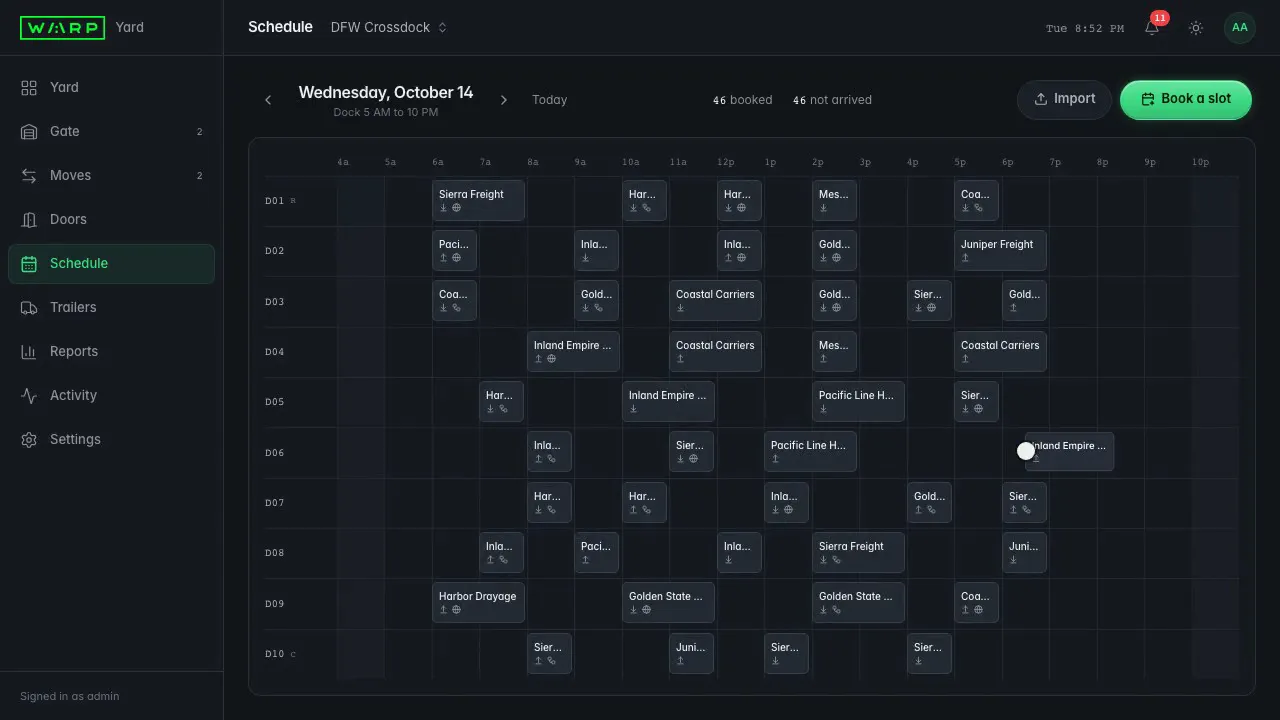
Every door is a row and every booking is a block. Drag one to a new time and it snaps to the quarter hour, checks the door is free, and saves. Hover an empty slot to book it.
- Recurring appointments and CSV import
- No-shows flagged after your grace period
- Warp shipments appear on their own
Actual app screen · Sample data
03Drivers
Drivers check in from their own phone.
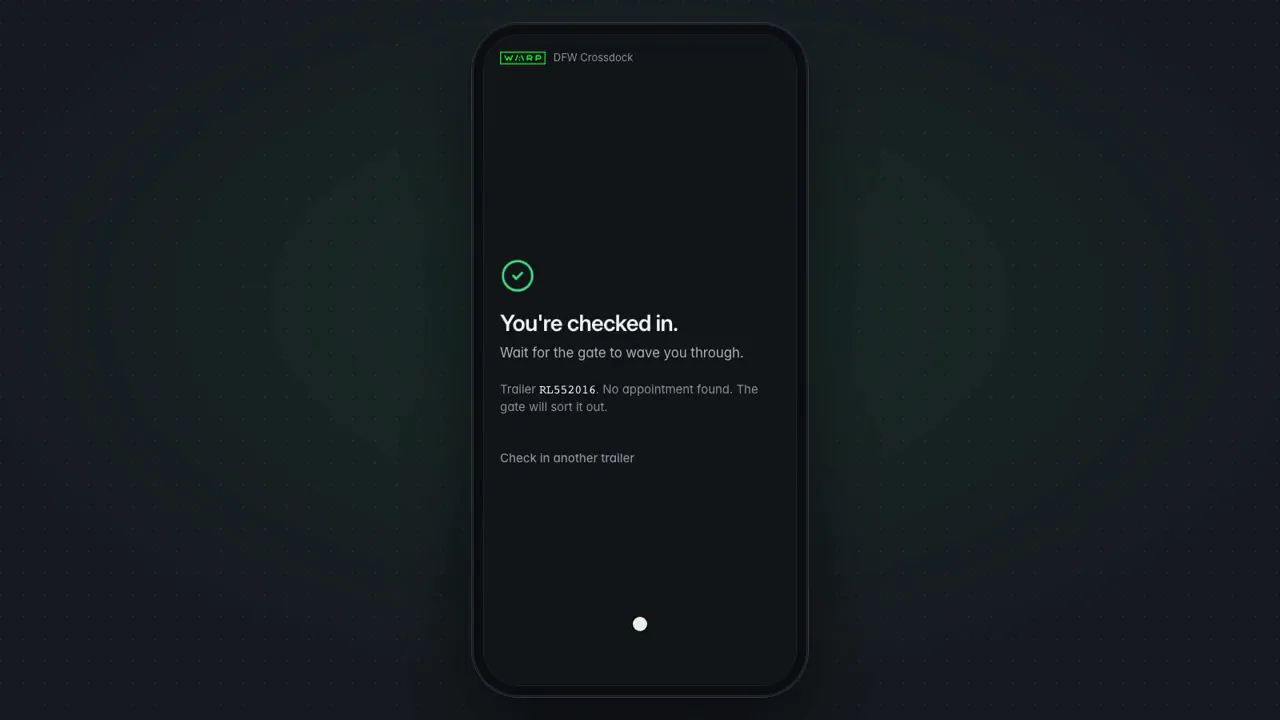
Post a QR code at the gate. Drivers scan it, type their trailer and carrier, and join the line at the gate window, with no app to install and no login. The gate sees them waiting and admits or turns away with one tap.
- Works on any phone browser
- Matches the driver to their appointment
- The gate keeps the final say
Actual app screen · Sample data
What is a yard management system?
A yard management system (YMS) is software that tracks trucks and trailers from the moment they reach the gate until they leave: where each trailer is parked, which dock door it is at, what is loaded, and how long it has been there. It also schedules dock appointments and measures dwell time and detention.
What does a yard management system do?
A YMS checks trucks in and out at the gate, keeps a live map of trailers at doors and parking spots, sends jockeys to move trailers, schedules dock appointments, and reports dwell, door utilization, and detention. Warp Yard does all of that and adds carrier self booking and driver check in from a phone.
Do truck drivers need an app to check in at the gate?
Not with Warp Yard. The yard posts a QR code at the gate; drivers scan it with any phone, type their trailer and carrier, and join the gate line. There is no app to install and no login. The gate sees them waiting and admits or turns them away.
How does a YMS reduce detention charges?
A YMS records the exact time a trailer arrives and leaves and compares it to each carrier's free time, so trailers running long show up before they cost money. Warp Yard flags trailers past free time on the yard map and adds detention up by carrier, with the rate and free time you set.
What is the difference between a YMS and a WMS?
A warehouse management system (WMS) manages inventory inside the building: receiving, putaway, picking, and shipping. A yard management system manages what happens outside it: trucks at the gate, trailers in the yard, dock doors, and appointments. They work side by side, and Warp Yard connects to other systems through its API and webhooks.
Warp customers






What you get, by the job it does
Warp Yard covers the six jobs a yard actually runs: the gate, the yard map, the doors, the dock schedule, carriers and drivers, and reports. Every one of them is live today.
Gate
In and out, on the record.
Check trucks in and out with trailer, carrier, seal, load, driver, and plate. Seals are checked again on the way out, and every visit keeps its inspection notes and photos.
Yard map
Every trailer, where it sits.
Doors and parking rows laid out like your yard. Drag a trailer to a door or spot to send a jockey, and edit the layout right on the map when the yard changes.
Doors
What every door is doing.
Unloading, loading, ready to pull, or blocked, with progress and time at the door. A blocked door raises an alert after the limit you set.
Schedule
Appointments that move.
A row per door and a block per booking. Drag to reschedule, book recurring slots, import a CSV, and catch no-shows after your grace period.
Carriers and drivers
They book and check in themselves.
Each carrier gets a booking link limited to your dock hours. Drivers scan a QR code at the gate and check in from their own phone.
Reports
Dwell and detention, counted.
Dwell, gate to door, door utilization, on-time appointments, no-shows, and detention dollars by carrier, with CSV export.
Detention that adds itself up
Every visit is timed from gate in to gate out, against each carrier's own free time.
Set a default free time and detention rate for the yard, and override them per carrier.
Warp Yard starts the clock at check in, marks trailers past free time on the yard map, and totals detention hours and dollars by carrier in reports.
The figures come from times your gate recorded, so they hold up when a carrier asks how you got the number.
Shipments booked with Warp show up on their own
If your company ships with Warp, inbound and outbound loads at your facility land on the dock schedule automatically.
Warp Yard checks Warp every ten minutes for shipments picking up or delivering at your address and keeps the schedule current, overnight included.
Freight from any other carrier works the same way once it is booked, imported, or checked in at the gate. Booking Warp is never required.
Who it's for
Distribution centers, crossdocks, manufacturers, and warehouses that still run the yard from a whiteboard, a spreadsheet, and a radio.
Setup is a street address, the number of dock doors, and your parking rows. Add your gate staff, supervisors, and jockeys with the role that fits, and each person sees what their job needs.
One account can run several sites, and every site keeps its own yard, schedule, and reports.
For your systems and developers
Warp Yard has a REST API with API keys and signed webhooks, so your WMS or TMS can see the yard.
Create and list appointments, read the yard, post gate reads and ETAs, and subscribe to events such as check in, check out, moves, door status, seals, inspections, and reefer readings.
Webhooks are signed and retried. API keys are shown once at creation and stored only as hashes, and access inside each yard follows its roles.
Frequently asked questions
Can carriers book their own dock appointments?
Yes. Each carrier gets its own booking link. Carriers see open slots inside your dock hours, book or reschedule their appointments, and only ever see their own bookings.
Your schedule updates the moment they book.
Does Warp Yard work if we don't ship with Warp?
Yes. Warp Yard is for any yard. You sign up with a Warp account, which is free to create, and run every truck from every carrier through it.
If you also ship with Warp, those shipments appear on your dock schedule by themselves.
How long does it take to set up Warp Yard?
Minutes. Sign up at warpyardmanagement.com, enter the yard address, the number of dock doors, and your parking rows, and the yard map is ready.
You can rename doors, add rows, or drag the layout around later, right on the map.
Can Warp Yard connect to our WMS or TMS?
Yes, through the REST API and signed webhooks, or by importing appointments from a CSV file. Shipments booked with Warp connect natively, with no setup.
Is our yard data private?
Yes. Your yard data belongs to you. Each customer's data is kept separate, people only see the yards they are added to, and carriers only see their own appointments.
Warp does not sell yard data or use it for advertising.
What does Warp Yard not do yet?
Warp Yard does not ship its own gate camera or ELD integrations yet, though a camera system can post gate reads and ETAs to the API. Drivers are not sent text message updates today.
Those are the honest edges of the current product.
How do I get started with Warp Yard?
Create your account at warpyardmanagement.com, set up your yard, and invite your team.
Post the driver check in QR code at the gate and send carriers their booking links, and the yard starts filling in from the first truck.
About the Warp freight network
More about the Warp freight network
Warp is the open source freight network: the tech is free and the network is open. We run Warp LTL, our own carrier, Warp FTL, cargo van, box truck and fulfillment ourselves, with every major LTL carrier, parcel, ocean and air plugged in beside them. Our driver app rides on every truck and our warehouse app runs every cross-dock, so an open network of 38,000+ carriers behaves like one carrier you control. Warp is licensed by the FMCSA as a property broker and freight forwarder, and runs the network itself: instant rates, live tracking, 70+ cross-dock facilities, 14,000+ cargo vans and box trucks, 80%+ US LTL zip-to-zip coverage and nationwide FTL, box truck and cargo van.
The network is supported by 24,000+ vetted FTL carriers.
Unlike traditional brokers, Warp uses AI to match the right vehicle to every load based on weight, dimensions, urgency, and cost targets. Cross-dock operations reduce transit time by eliminating unnecessary terminal transfers.
Pool distribution and zone-skipping programs help enterprise shippers lower per-unit delivery costs while maintaining tight appointment windows.
Self-serve shippers can quote, compare, and book freight online in under two minutes. Enterprise accounts get dedicated capacity planning, committed rate programs, and a named operations team. Every shipment includes scan-level visibility from pickup through final delivery.
Warp operates across the contiguous United States with regional density in the Southeast, Texas, Midwest, and Northeast corridors, and West Coast and Southwest coverage from Los Angeles, Seattle and Phoenix.
Warp operates 70+ cross-dock facilities across the US, with named markets including Chicago, Atlanta, Houston, New York, Savannah, Orlando, Charlotte, Indianapolis, Columbus, Denver, New Orleans, Milwaukee, Dallas-Fort Worth, Nashville, Phoenix, Tampa Bay, Seattle, Los Angeles. They support faster transfers and fewer touches on recurring lanes.
Freight modes and vehicle types
| Mode | Max payload | Max cube | Best for |
|---|---|---|---|
| Cargo van | 3,500 lbs | 400 cu ft | Time-sensitive, last-mile, light pallets |
| Box truck | 10,000 lbs | 1,500 cu ft | Regional distribution, no dock required |
| LTL | Per-pallet | Shared trailer | Lower per-pallet cost via cross-dock routing |
| Dry van / FTL | 42,000+ lbs | Full 53-ft trailer | High-volume lanes, recurring programs |
Cargo vans handle loads up to 3,500 pounds and 400 cubic feet, ideal for time-sensitive deliveries, last-mile retail replenishment, and lightweight palletized freight.
Box trucks carry up to 10,000 pounds and 1,500 cubic feet, fitting most regional distribution and store delivery needs without requiring a loading dock.
Dry vans and full truckloads move 42,000+ pounds for high-volume lanes and recurring programs. LTL shipments share trailer space on optimized routes through Warp cross-docks, reducing per-pallet cost by consolidating multiple shippers on the same vehicle.
Warp does not default every shipment to a 53-foot trailer. The AI engine evaluates load weight, cube, delivery window, and cost to recommend the right vehicle. Shippers see all available mode options with live pricing in one comparison screen before booking.
Cross-dock operations
Cross-docking at Warp facilities keeps freight moving instead of storing it: inbound freight is sorted and transferred directly to outbound vehicles, typically within hours. When inventory does need to sit, Warp's fulfillment centers in Los Angeles, Dallas, Chicago and New Jersey hold it inside the same network, with same day delivery within 30 miles of each.
This reduces dwell time, lowers damage risk, and compresses delivery windows. Warp cross-docks support pallet-in, pallet-out operations with scan-level tracking at every handoff point.
- Atlanta — Southeast retail flow
- Chicago — Midwest manufacturing and replenishment
- Houston — Texas industrial distribution
- New York — dense Northeast delivery
Facility locations are selected for corridor density: Atlanta handles Southeast retail flow, Chicago serves Midwest manufacturing and replenishment, Houston covers Texas industrial distribution, and New York supports dense Northeast delivery. Each facility operates on appointment-based scheduling to prevent congestion and maintain throughput consistency.
Enterprise freight programs
Enterprise shippers get committed rate programs, dedicated account management, and custom SLA design. Warp builds lane-by-lane rate structures that account for volume commitments, seasonal variation, and mode flexibility. Operations teams monitor shipment execution daily and intervene proactively when exceptions occur.
Self-serve freight quoting
Shippers enter origin and destination, load details, and delivery requirements to see live rates across all available modes. Quotes include estimated transit time, vehicle type, and total cost.
Booking takes one click. After booking, shippers track every shipment with real-time GPS location, milestone updates, and proof of delivery documentation.
Industries and use cases
Retail shippers use Warp for store replenishment programs that deliver to hundreds of locations per week on tight appointment windows. Apparel brands use zone skipping to bypass regional parcel sortation and reduce per-unit delivery cost.
Food and beverage companies rely on time-definite delivery for perishable goods. Manufacturing operations use Warp for inbound vendor consolidation, combining multiple supplier shipments into fewer, fuller loads through cross-dock facilities.
Distribution companies use pool distribution to serve multiple delivery points from a single origin, splitting full truckloads at cross-docks into smaller last-mile vehicles.
Urgent freight recovery covers emergency capacity needs when primary carriers fail or demand spikes unexpectedly. Middle-mile optimization reduces cost and transit time on the longest segment of multi-leg shipments.
Your yard, live.
Create your account at warpyardmanagement.com, enter your address and doors, and check in your first truck. Carriers book their own slots, drivers check in from their phone, and detention adds itself up.
Gate · Yard map · Doors · Dock schedule · Carrier booking · Driver check in · Detention reports
Performance figures are computed from Warp network data. See our methodology.
By Troy Lester