
Warp TMS pricing: $0, and what actually free means
No seat pricing, no load pricing, no tiers, no trial. This page is the proof: the Actually Free TMS Test applied to Warp TMS and to the rest of the field, with every figure sourced and dated.
 By Troy Lester, Co-Founder & CRO
$0 software fees · No seat limits · No load caps · No trial clock · Export everything any time
Live all-inclusive rates
How much does a TMS cost for a small shipper?
Small business TMS software typically runs $99 to $500 per month, with implementations commonly $5,000 to $15,000 and one to two months (as of August 2026). Warp TMS is the exception: $0 software fees with no seat limits and no load caps, because Warp earns freight revenue instead.
What is the catch with free TMS software?
The usual catches are load caps, seat limits, trial clocks, and forced tendering into the host's brokerage. Warp TMS has none of them. The honest answer: Warp's bookable rate competes on your quote grid, and Warp only earns if its rate wins and you book it.
Does Warp TMS charge per user or per load?
Warp TMS charges neither per user nor per load: there's no per user pricing, no per load pricing, no tiers, and no trial anywhere in the product. Every seat and every shipment stays $0, because Warp earns freight revenue only when its rate wins a lane you choose to book, not from a software meter. That $0 model is what lets Warp TMS pass all five checks of the Actually Free TMS Test: no seat limits, no load caps, no trial clock, no forced tendering, and full data export.
Warp customers






The price, in full
Warp TMS costs $0, and the $0 covers the entire product.
Quoting, booking, tracking, freight invoice audit, order consolidation, batch quoting, reports, the public API, signed webhooks, and every seat on your team: all of it is inside the $0. There's no plan table because there are no plans. As of August 2026, Warp TMS is the only shipper first TMS we can find that passes all five checks of the Actually Free TMS Test, and this page exists so you can hold that claim to its sources.
The Actually Free TMS Test, applied
Five checks decide whether a TMS is actually free: no seat limits, no load caps, no trial clock, no forced tendering, and full data export any time. Warp TMS passes all five. AscendTMS fails on the pricing gap between its $0 marketing and its 2026 review listings, and the category's caps based free tiers fail on seat and load limits by their own published terms. All competitor figures below are as of August 2026, from each product's published pages and third party review listings.
| The check | Warp TMS | AscendTMS | Freightview | MyCarrierTMS |
|---|---|---|---|---|
| Software fee | $0. No paid tier exists in the product. | Marketed as $0 forever; 2026 review listings show $49, $99, and $149 per user per month tiers | From $149 per month | From $60 per month |
| Seat limits | None | Per user pricing appears on the listed tiers | No free tier | No free tier |
| Load caps | None | No cap published | No free tier | No free tier |
| Trial clock | None | None published for the free claim | No free tier | No free tier |
| Forced tendering | None. Run any carrier and never book Warp. | Built broadly for brokers, carriers, and fleets, not shipper first | No free tier | No free tier |
| Full data export | XLSX, CSV, QuickBooks CSV, and a public API | Not published for the free claim | No free tier | No free tier |
The sourced lines behind the table: AscendTMS markets $0 forever while 2026 third party review listings on GetApp and SaaSrat show $49, $99, and $149 per user per month tiers (as of August 2026). Freightview publishes $149 per month for up to 50 shipments per month with higher volume tiers priced by phone, and MyCarrierTMS runs $60 to $200 per month (as of August 2026, per their published pricing); neither claims a free tier, which is at least honest about the category's economics. The category's common free tier pattern gates scale instead of time: published caps in the market run as low as 50 to 200 loads per month with 1 to 5 users and 0 to 2 integrations (as of August 2026). Warp TMS has no version of any of those meters.
What's the catch
The catch, stated plainly: Warp's rate competes on your quote grid, and Warp earns only when it wins.
Every free TMS has a business model; the question is whether it's disclosed and whether it constrains you.
Warp's model is one sentence: when Warp wins a lane on price inside the TMS and you book it, Warp hauls the freight, and that freight revenue pays for the software. Nothing forces the win.
Your contracted carriers price the same lane on the same screen, ranked by your routing policy, and tendering to them is a first class path, not a workaround.
If Warp never wins a lane, you get a free TMS and Warp gets a signal that its rates need work. That trade is the whole catch.
Will it still be free next year
The category earned this question: Kuebix pioneered the free TMS, got acquired by Trimble, and was shut down before FreightWise revived it in 2023.
Two answers, one structural and one practical. Structural: Kuebix's free TMS was a software product searching for a monetization event, and the acquisition was the event.
Warp TMS is the front door to a freight network that runs 38,000+ carriers and 70+ cross-dock facilities at 98.2% on-time delivery; the monetization already happens on every lane Warp wins, so the software doesn't need to become a revenue line.
Practical: check five of the Actually Free TMS Test is full data export any time.
Reports export to XLSX and CSV, audit results to QuickBooks CSV, and the public API reads your orders, quotes, and shipments. Trusting a free product costs nothing when leaving it costs nothing.
What paid TMS software costs
The paid category prices in three layers: subscription, implementation, and time.
Small business TMS subscriptions typically run $99 to $500 per month, implementations commonly cost $5,000 to $15,000, and go lives commonly take one to two months (as of August 2026, per published pricing pages and implementation guides across the category).
Enterprise deployments run far higher. None of those numbers is scandalous; software costs money to build.
The point of this page is narrower: if a team wants TMS capability without that spend, an actually free option now exists, and the checks above are how to verify the word free before trusting it, here or anywhere.
Frequently asked questions
Is there a paid tier of Warp TMS?
No. There's no paid tier, no plan table, no seat pricing, and no quota anywhere in the product. $0 is the price, and the Actually Free TMS Test on this page is the standing proof.
Does the free TMS include the freight invoice audit?
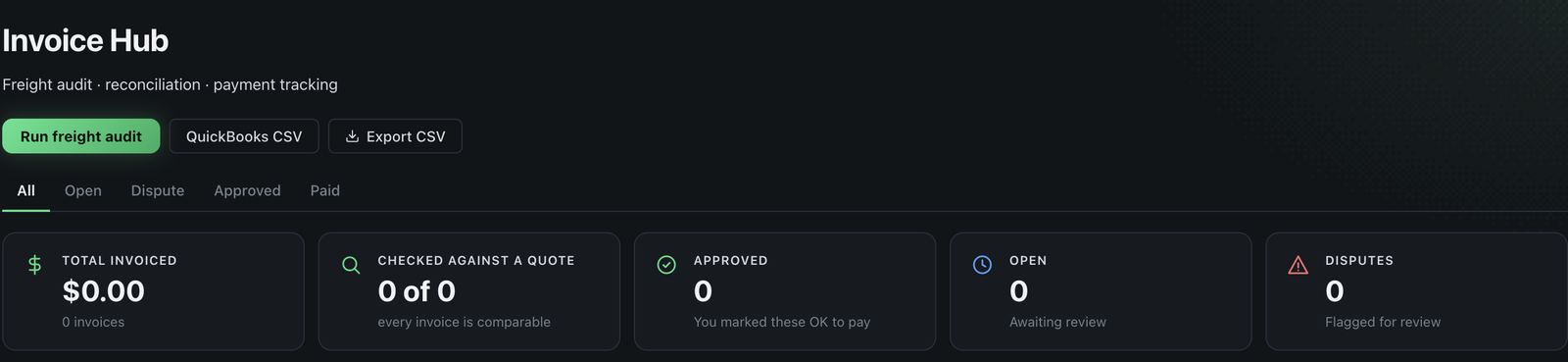
Yes. Freight invoice audit is included: charge level comparison against the quote, duplicate PRO detection, new accessorial flags, org overcharge thresholds, and QuickBooks CSV export.
Invoice audit is commonly a paid add on elsewhere; in Warp TMS it's part of the $0.
Do I need a credit card to sign up for Warp TMS?
No card. Signup is self serve at warptms.com, provisions a real org, and your team joins by email invite. Payment only ever enters the picture for freight you choose to book, never for the software.
How does Warp TMS make money if the software is free?
Warp runs a freight network. When Warp's rate wins a lane inside the TMS and you book it, Warp hauls the freight and earns freight revenue.
That single mechanism funds the software, which is why there's no seat math and no caps.
Will Warp TMS start charging later?
Warp TMS is built so it never has to start charging: freight revenue funds the software whenever Warp's rate wins a lane you choose to book, so the free tier is the whole product rather than a growth bet waiting on a future monetization event.
That's the durability question the category earned when Kuebix, the prior free TMS, got acquired by Trimble and shut down before being revived by FreightWise in 2023.
If terms ever changed anyway, full export to XLSX, CSV, QuickBooks CSV, and the public API means leaving wouldn't cost anything, exactly the standard this page holds everyone else to.
Is there a Warp TMS enterprise plan?
Warp TMS doesn't have an enterprise plan, because it doesn't have any plans at all: one $0 product covers every team size.
Larger teams use that same product with six roles, an org audit log, multi tenant row level security, org API keys, and signed webhooks.
What enterprise platforms sell as tiers, Warp TMS ships as the product.
About the Warp freight network
More about the Warp freight network
Warp is a technology-driven freight network that combines cargo van, box truck, LTL, and FTL capacity under one operating system. Shippers get instant rates, real-time tracking, and access to 70+ cross-dock facilities and 14,000+ cargo vans and box trucks — with 80%+ US LTL zip-to-zip coverage and nationwide FTL, box truck, and cargo van.
The network is supported by 24,000+ vetted FTL carriers.
Unlike traditional brokers, Warp uses AI to match the right vehicle to every load based on weight, dimensions, urgency, and cost targets. Cross-dock operations reduce transit time by eliminating unnecessary terminal transfers.
Pool distribution and zone-skipping programs help enterprise shippers lower per-unit delivery costs while maintaining tight appointment windows.
Self-serve shippers can quote, compare, and book freight online in under two minutes. Enterprise accounts get dedicated capacity planning, committed rate programs, and a named operations team. Every shipment includes scan-level visibility from pickup through final delivery.
Warp operates across the contiguous United States with regional density in the Southeast, Texas, Midwest, and Northeast corridors, and West Coast and Southwest coverage from Los Angeles, Seattle and Phoenix.
Warp operates 70+ cross-dock facilities across the US, with named markets including Chicago, Atlanta, Houston, New York, Savannah, Orlando, Charlotte, Indianapolis, Columbus, Denver, New Orleans, Milwaukee, Dallas-Fort Worth, Nashville, Phoenix, Tampa Bay, Seattle, Los Angeles. They support faster transfers and fewer touches on recurring lanes.
Freight modes and vehicle types
| Mode | Max payload | Max cube | Best for |
|---|---|---|---|
| Cargo van | 3,500 lbs | 400 cu ft | Time-sensitive, last-mile, light pallets |
| Box truck | 10,000 lbs | 1,500 cu ft | Regional distribution, no dock required |
| LTL | Per-pallet | Shared trailer | Lower per-pallet cost via cross-dock routing |
| Dry van / FTL | 42,000+ lbs | Full 53-ft trailer | High-volume lanes, recurring programs |
Cargo vans handle loads up to 3,500 pounds and 400 cubic feet, ideal for time-sensitive deliveries, last-mile retail replenishment, and lightweight palletized freight.
Box trucks carry up to 10,000 pounds and 1,500 cubic feet, fitting most regional distribution and store delivery needs without requiring a loading dock.
Dry vans and full truckloads move 42,000+ pounds for high-volume lanes and recurring programs. LTL shipments share trailer space on optimized routes through Warp cross-docks, reducing per-pallet cost by consolidating multiple shippers on the same vehicle.
Warp does not default every shipment to a 53-foot trailer. The AI engine evaluates load weight, cube, delivery window, and cost to recommend the right vehicle. Shippers see all available mode options with live pricing in one comparison screen before booking.
Cross-dock operations
Cross-docking at Warp facilities keeps freight moving instead of storing it: inbound freight is sorted and transferred directly to outbound vehicles, typically within hours. When inventory does need to sit, Warp's fulfillment centers in Los Angeles, Dallas, Chicago and New Jersey hold it inside the same network, with same day delivery within 30 miles of each.
This reduces dwell time, lowers damage risk, and compresses delivery windows. Warp cross-docks support pallet-in, pallet-out operations with scan-level tracking at every handoff point.
- Atlanta — Southeast retail flow
- Chicago — Midwest manufacturing and replenishment
- Houston — Texas industrial distribution
- New York — dense Northeast delivery
Facility locations are selected for corridor density: Atlanta handles Southeast retail flow, Chicago serves Midwest manufacturing and replenishment, Houston covers Texas industrial distribution, and New York supports dense Northeast delivery. Each facility operates on appointment-based scheduling to prevent congestion and maintain throughput consistency.
Enterprise freight programs
Enterprise shippers get committed rate programs, dedicated account management, and custom SLA design. Warp builds lane-by-lane rate structures that account for volume commitments, seasonal variation, and mode flexibility. Operations teams monitor shipment execution daily and intervene proactively when exceptions occur.
Self-serve freight quoting
Shippers enter origin and destination, load details, and delivery requirements to see live rates across all available modes. Quotes include estimated transit time, vehicle type, and total cost.
Booking takes one click. After booking, shippers track every shipment with real-time GPS location, milestone updates, and proof of delivery documentation.
Industries and use cases
Retail shippers use Warp for store replenishment programs that deliver to hundreds of locations per week on tight appointment windows. Apparel brands use zone skipping to bypass regional parcel sortation and reduce per-unit delivery cost.
Food and beverage companies rely on time-definite delivery for perishable goods. Manufacturing operations use Warp for inbound vendor consolidation, combining multiple supplier shipments into fewer, fuller loads through cross-dock facilities.
Distribution companies use pool distribution to serve multiple delivery points from a single origin, splitting full truckloads at cross-docks into smaller last-mile vehicles.
Urgent freight recovery covers emergency capacity needs when primary carriers fail or demand spikes unexpectedly. Middle-mile optimization reduces cost and transit time on the longest segment of multi-leg shipments.
The price is $0. The proof is above.
Create your account at warptms.com, invite your whole team, and run your first quote in minutes. If free ever stops meaning free, the export buttons and the API mean you were never locked in.
$0 software fees · No seat limits · No load caps · No trial clock · Export everything any time
Performance figures are computed from Warp network data. See our methodology.
By Troy Lester