
Warp self-service portal vs FreightQuote.
FreightQuote is a broker-operated quote tool that routes through traditional NMFC-class LTL carriers and goes phone-heavy on real volume. The Warp portal is a direct multi-carrier shipper platform with flat per-pallet LTL (no freight class, no reclassification), auto-generated BOL and POD, public tracking links, and a self-service Freight API. Different pricing model. Different operating motion.
98.2% on-time delivery · $100K carrier liability · Up to $1M coverage · 2,000+ shippers · No subscription
Live all-inclusive rates
Warp customers






No freight class. No reclassification. No callback.
FreightQuote requires NMFC class codes and routes through broker phone support. Here is how Warp prices and books freight instead.
Enter shipment details on the public quote page
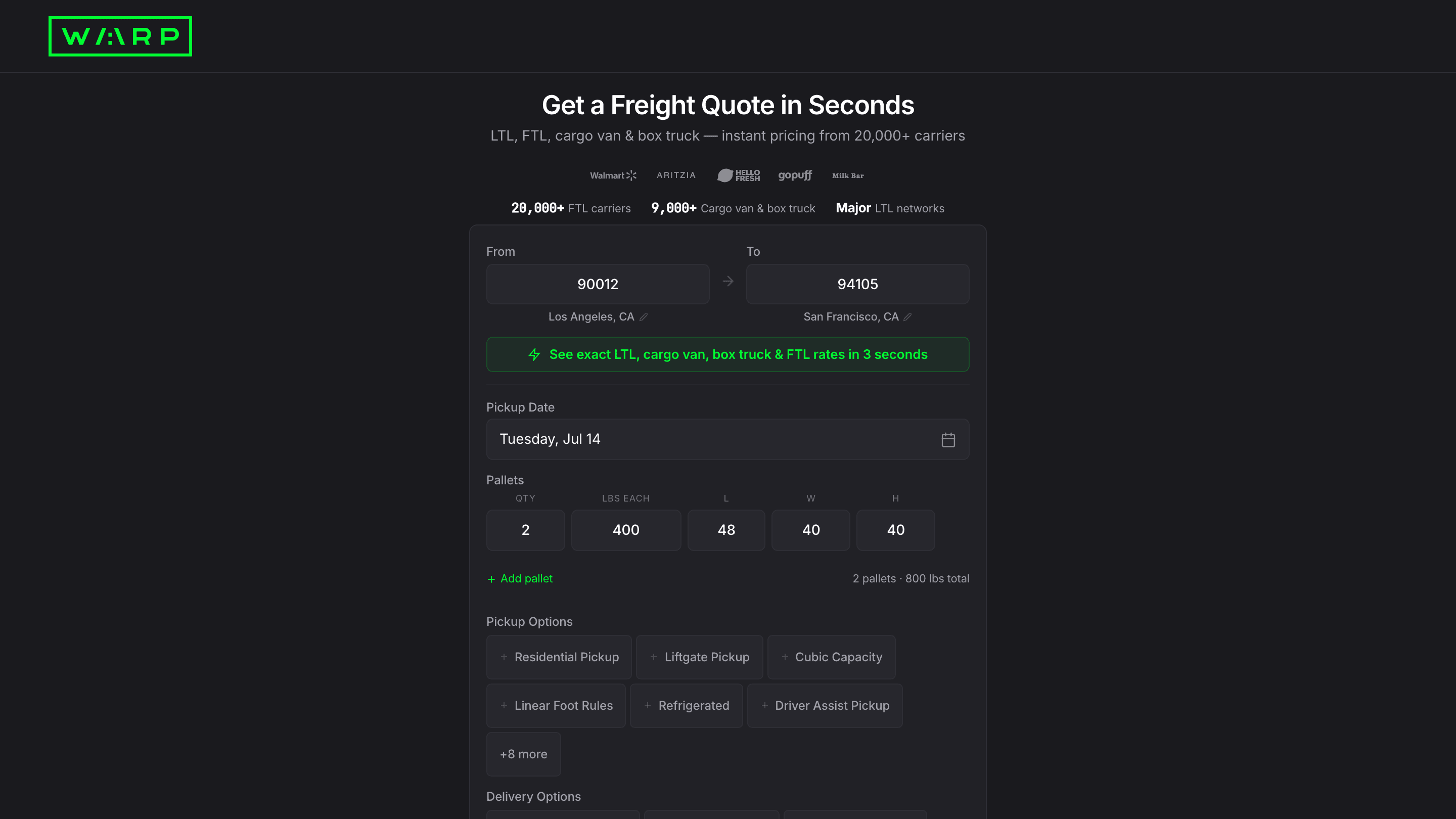
Go to customer.wearewarp.com/public/freight-quote. Enter your origin and destination ZIP codes, pick a date, set pallet count with weight and dimensions, and toggle any services you need (liftgate, residential, refrigerated, driver assist, and more). Click Get Rates. No account required.
The quote page is public: no login, no signup required. The pallet configurator calculates total weight live. Services Needed toggles map to accessorial codes the rating engine uses to include or exclude surcharges. No freight class or NMFC code is required. Warp prices flat per pallet.
Compare live rates and select the best option
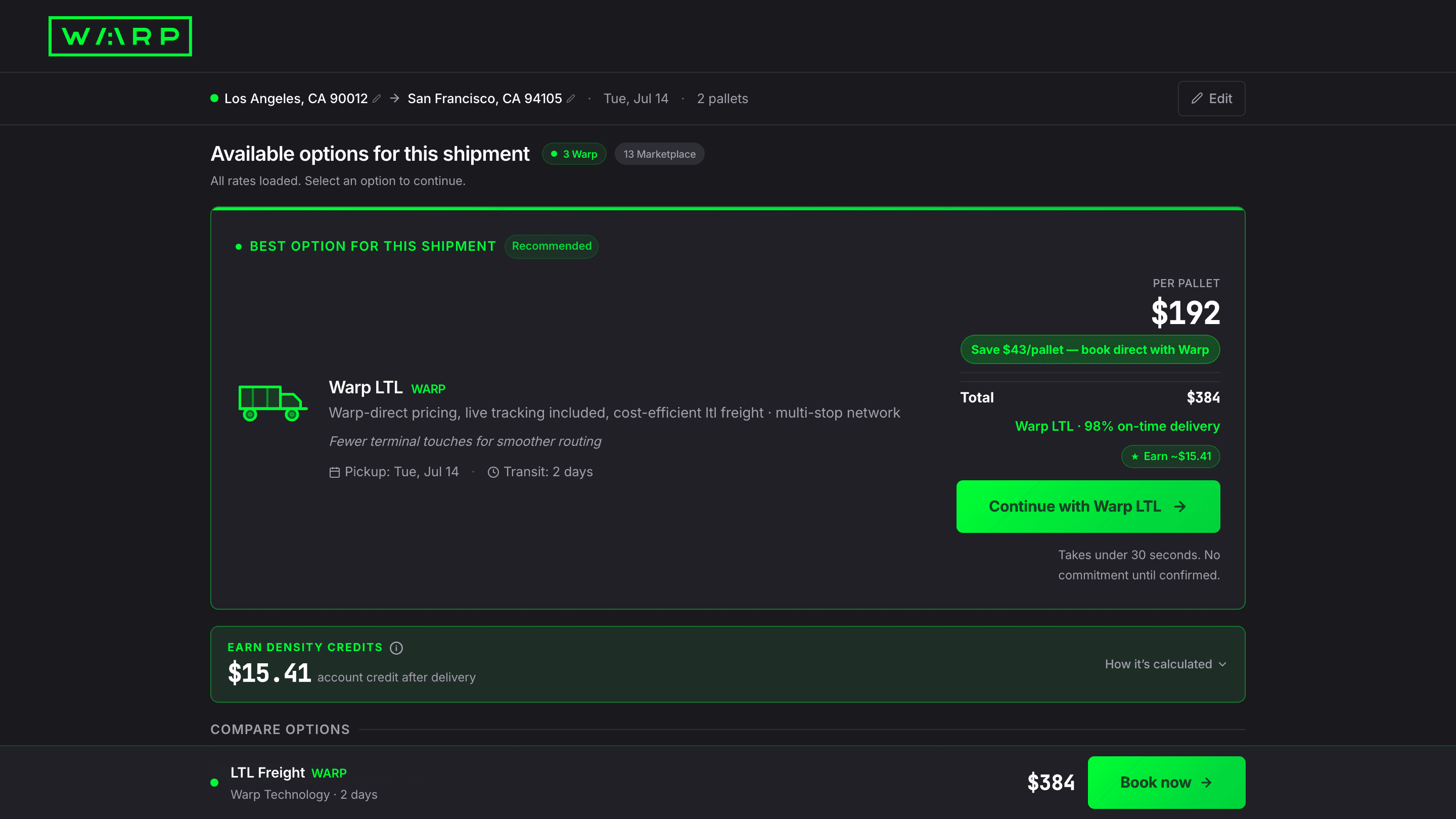
Rates load in under 10 seconds. The top card is flagged Best Option with per-pallet price, total cost, savings vs retail, on-time percentage, and transit time. Click Continue to proceed to checkout, or scroll to see additional carrier options.
The rating engine queries every available carrier and mode on the lane in under 10 seconds. The Best Option tag goes to the lowest all-inclusive per-pallet cost. Rates are locked once you click Continue: no reclassification, no post-delivery adjustments.
Fill pickup details and toggle Falvey cargo insurance
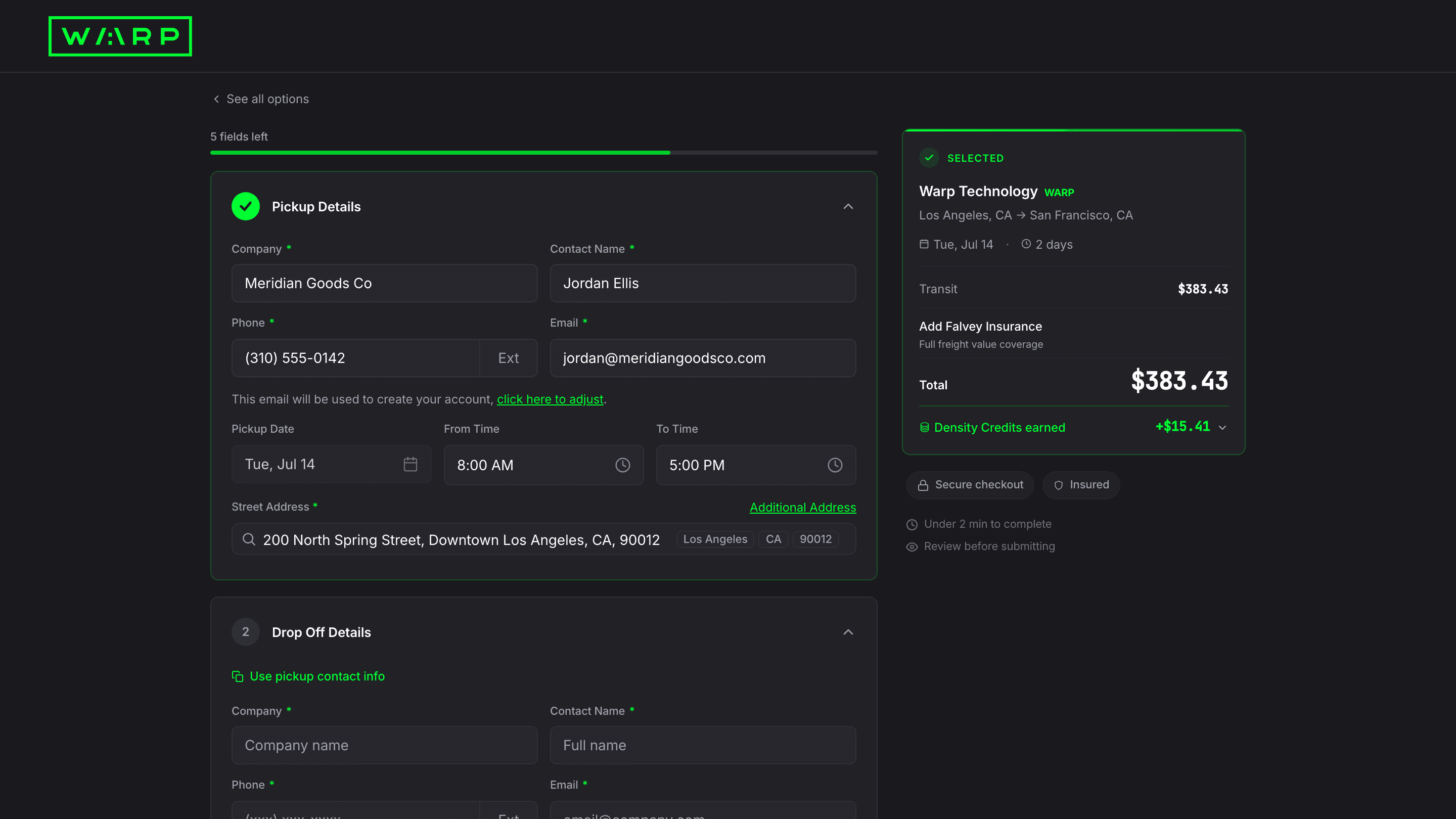
Enter your pickup company, contact, address, and time window. The email you enter becomes your Warp account login. In the sidebar, toggle Add Falvey Insurance to get all-risk cargo coverage. The premium calculates instantly. The sidebar shows your running total with transit cost, insurance, and subtotal.
The email you enter at checkout becomes your Warp account login. The system creates your account as part of the booking flow so you never need a separate signup. Falvey Insurance is powered by Falvey Insurance Underwriters. The insurance certificate generates immediately after booking.
Download the auto-generated Bill of Lading
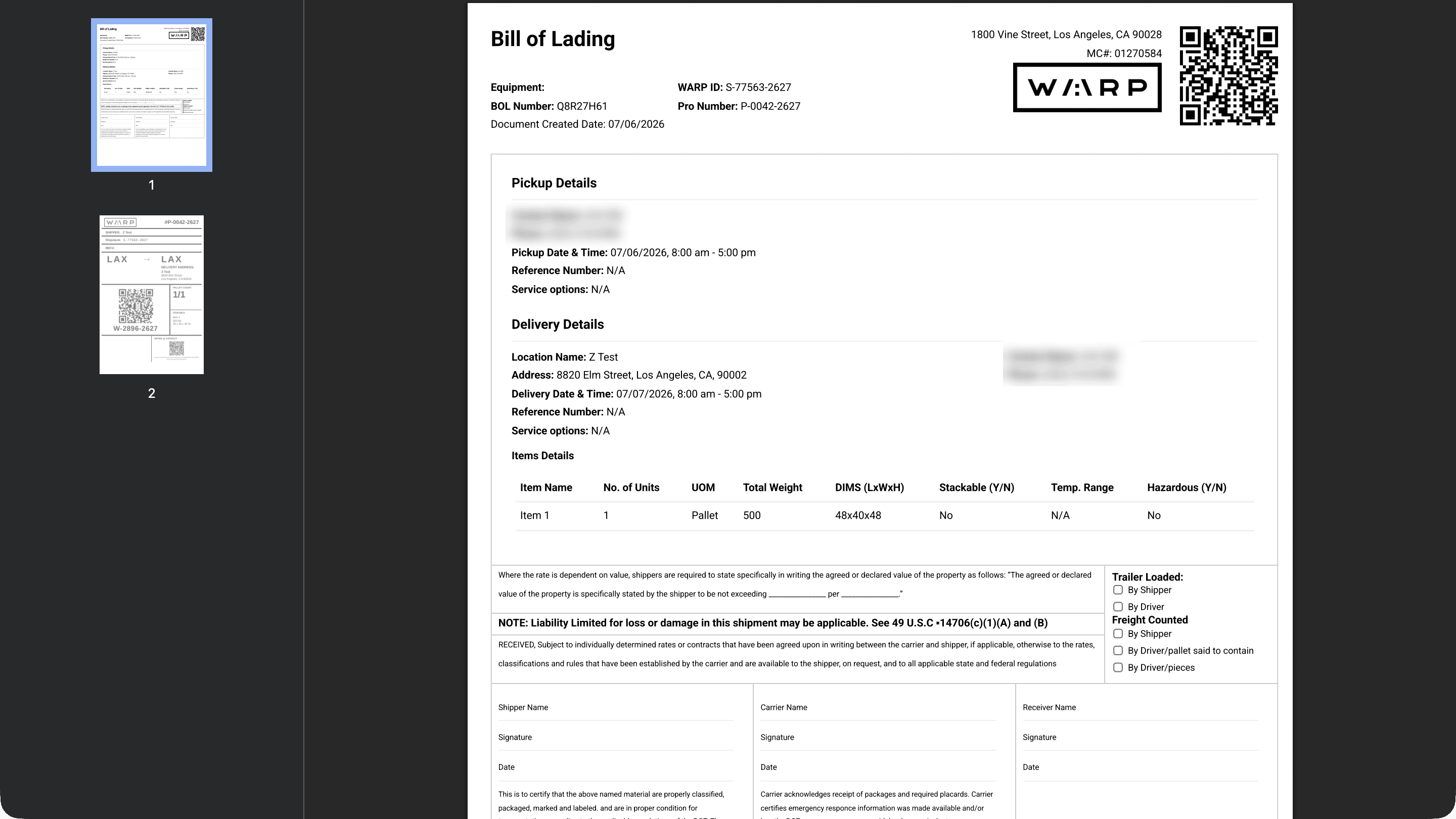
Click View BOL. The PDF is pre-filled with a scannable QR code, your WARP ID, BOL number, pickup and delivery addresses with contacts, an items table with pallet count/weight/dimensions, and the Carmack Amendment liability clause. Signature lines for Shipper, Carrier, and Receiver are ready for pickup.
BOLs are generated server-side from your booking data and stored in encrypted object storage. The QR code encodes the WARP ID for quick dock lookup. Driver signature at pickup is captured via the Warp driver app, and the signed version replaces the blank one in Documents within minutes.
Pricing model: flat per-pallet vs NMFC class with reclassification
FreightQuote routes LTL through NMFC-class carriers. You declare a freight class, and the carrier can reclassify your shipment after delivery — invoices often land 20-40% higher than quoted.
Warp prices LTL flat per pallet: enter pallet count, weight, and dimensions. No class code, no NMFC lookup. The invoice always matches the quote.
Carrier coverage: same carriers, direct relationships
Both platforms access FedEx Freight, XPO, Old Dominion, SAIA, Estes, R+L, ABF, and TForce.
Warp also dispatches 24,000+ FTL carriers and 14,000+ cargo van and box truck partners, and operates 70+ cross-dock facilities. Warp owns the relationships and prices the capacity directly.
FreightQuote adds a broker markup and hands the load to the carrier's terminal network.
Who should use which
Use FreightQuote if your TMS has a Navisphere integration you prefer or your organization requires NMFC-class pricing for compliance.
Use Warp when you want flat per-pallet pricing, auto-generated BOL and POD, public tracking for consignees, self-service API access, or a single surface across LTL, FTL, cargo van, and box truck.
Migration path from FreightQuote to Warp
Create a Warp account at customer.wearewarp.com. Quote your current FreightQuote lanes — no freight class needed, just pallet count, weight, and dimensions.
Book your first shipment with code WARP2026 for $50 off — good on LTL, FTL, box truck, or cargo van.
If your TMS integrates with Navisphere, generate a Warp API key from Settings and point the TMS at the Warp OpenAPI spec. Most shippers complete the switch in under two weeks.
Frequently asked questions
What is the difference between Warp and FreightQuote?
FreightQuote by CH Robinson is a broker-operated quote tool that routes through traditional LTL carriers.
Quotes require freight class lookups and NMFC codes, and post-delivery reclassification can increase your invoice.
Warp is a direct multi-carrier shipper portal with flat per-pallet LTL (no freight class, no NMFC, no reclassification), auto-generated BOL and POD, public tracking links, and a Freight API — all self-service, no broker intermediation.
Can I move my FreightQuote history to Warp?
FreightQuote does not export shipment history in a portable format. To move, create a Warp account at customer.wearewarp.com and re-quote your common lanes.
Warp saves them as Top Warp LTL Lanes for one-click re-booking, so recurring moves are back to one-click within the first week.
If you use FreightQuote via a TMS integration, request your TMS vendor to point their API credentials at Warp's Freight API instead.
Why does FreightQuote ask for freight class?
FreightQuote routes through traditional National Motor Freight Classification (NMFC) LTL carriers, which price freight based on class codes (ranging roughly 50 through 500) determined by density, handling, stowability, and liability.
If the carrier's post-delivery inspection disagrees with your declared class, your invoice gets reclassified and charged at a higher rate.
Warp prices LTL flat per pallet — no class, no NMFC lookup, no reclassification risk. The rate at booking is the rate on your invoice.
Does FreightQuote have an API?
FreightQuote offers API access through CH Robinson Navisphere, but it requires a sales engagement to set up and is geared toward enterprise integration.
Warp's Freight API is self-service: generate a key from the portal Settings page, read the OpenAPI spec at wearewarp.com/api/v1/openapi.json, and integrate against quoting, booking, tracking, invoices, and documents.
Webhooks are HMAC-signed POST requests on every milestone.
Is Warp cheaper than FreightQuote?
Warp LTL averages 24% lower per-pallet cost than traditional NMFC-class LTL carriers.
FreightQuote rates may look competitive at booking but often increase after delivery due to fuel surcharges, accessorial fees, and class reclassification.
Warp's flat per-pallet model means the invoice matches the quote — typically a 20 to 40% total-cost improvement on shipments that would have been reclassed by a traditional LTL carrier.
Does Warp work with the same carriers FreightQuote uses?
Yes.
Warp's network includes the same major LTL carriers FreightQuote quotes — FedEx Freight, XPO, Old Dominion, SAIA, Estes, R+L Carriers, ABF Freight, TForce Freight — plus Warp's own hub-and-spoke LTL service and 24,000+ FTL and 14,000+ cargo van and box truck partners.
The difference is how Warp prices them: flat per-pallet for LTL cross-dock routing, all-inclusive FTL, and a single portal and API surface across every mode.
How does tracking compare between Warp and FreightQuote?
FreightQuote relies on the underlying carrier's tracking, which typically means check calls at pickup and delivery and limited visibility in between.
Warp provides live GPS every 60 seconds from the Warp driver app on cargo van and box truck loads, cross-dock scan events on LTL, and a 4-stage progress bar on every shipment.
Public tracking URLs let you share status with consignees without giving them portal access.
Can I call someone at Warp like I can at FreightQuote?
Yes, customer support is reachable at +1 213 267 1373, Monday through Friday 6am to 10pm local.
But most Warp shippers never need to call — quotes return instantly, booking is self-service, documents auto-generate, and Orbit flags exceptions proactively.
Phone support exists for edge cases on commingable freight (cross-border coordination, guaranteed delivery windows, volume LTL).
Hazmat, oversize, and flatbed are not Warp services — those are routed to specialty brokers. FreightQuote's phone-heavy workflow is the rule. With Warp it is the exception.
Does FreightQuote generate a Bill of Lading automatically?
FreightQuote's BOL generation varies by integration path — online users may get a PDF, phone-booked shipments often require you to create your own.
Warp auto-generates a fully pre-filled BOL with Carmack Amendment liability, equipment details, pickup and delivery info, and the freight items table on every shipment.
Driver signature via the Warp app replaces the blank with the signed version in Documents within minutes of pickup.
Will a class-change dispute with FreightQuote transfer to Warp?
No. Warp prices LTL flat per pallet — there is no NMFC class assignment, so there is no reclassification and no dispute surface. The rate you quote is the rate you pay.
Carmack Amendment liability up to $100K is included on every shipment with no separate fuel surcharge or accessorial fee line.
Optional Falvey cargo coverage up to $1M is available as an in-booking toggle.
About the Warp freight network
More about the Warp freight network
Warp is the open source freight network: the tech is free and the network is open. We run Warp LTL, our own carrier, Warp FTL, cargo van, box truck and fulfillment ourselves, with every major LTL carrier, parcel, ocean, air and drayage plugged in beside them. Our driver app rides on every truck and our warehouse app runs every cross-dock, so an open network of 38,000+ carriers behaves like one carrier you control. Warp is licensed by the FMCSA as a property broker and freight forwarder, and runs the network itself: instant rates, live tracking, 70+ cross-dock facilities, 14,000+ cargo vans and box trucks, 80%+ US LTL zip-to-zip coverage and nationwide FTL, box truck and cargo van.
The network is supported by 24,000+ vetted FTL carriers.
Unlike traditional brokers, Warp uses AI to match the right vehicle to every load based on weight, dimensions, urgency, and cost targets. Cross-dock operations reduce transit time by eliminating unnecessary terminal transfers.
Pool distribution and zone-skipping programs help enterprise shippers lower per-unit delivery costs while maintaining tight appointment windows.
Self-serve shippers can quote, compare, and book freight online in under two minutes. Enterprise accounts get dedicated capacity planning, committed rate programs, and a named operations team. Every shipment includes scan-level visibility from pickup through final delivery.
Warp operates across the contiguous United States with regional density in the Southeast, Texas, Midwest, and Northeast corridors, and West Coast and Southwest coverage from Los Angeles, Seattle and Phoenix.
Warp operates 70+ cross-dock facilities across the US, with named markets including Chicago, Atlanta, Houston, New York, Savannah, Orlando, Charlotte, Indianapolis, Columbus, Denver, New Orleans, Milwaukee, Dallas-Fort Worth, Nashville, Phoenix, Tampa Bay, Seattle, Los Angeles. They support faster transfers and fewer touches on recurring lanes.
Freight modes and vehicle types
| Mode | Max payload | Max cube | Best for |
|---|---|---|---|
| Cargo van | 3,500 lbs | 400 cu ft | Time-sensitive, last-mile, light pallets |
| Box truck | 10,000 lbs | 1,500 cu ft | Regional distribution, no dock required |
| LTL | Per-pallet | Shared trailer | Lower per-pallet cost via cross-dock routing |
| Dry van / FTL | 42,000+ lbs | Full 53-ft trailer | High-volume lanes, recurring programs |
Cargo vans handle loads up to 3,500 pounds and 400 cubic feet, ideal for time-sensitive deliveries, last-mile retail replenishment, and lightweight palletized freight.
Box trucks carry up to 10,000 pounds and 1,500 cubic feet, fitting most regional distribution and store delivery needs without requiring a loading dock.
Dry vans and full truckloads move 42,000+ pounds for high-volume lanes and recurring programs. LTL shipments share trailer space on optimized routes through Warp cross-docks, reducing per-pallet cost by consolidating multiple shippers on the same vehicle.
Warp does not default every shipment to a 53-foot trailer. The AI engine evaluates load weight, cube, delivery window, and cost to recommend the right vehicle. Shippers see all available mode options with live pricing in one comparison screen before booking.
Cross-dock operations
Cross-docking at Warp facilities keeps freight moving instead of storing it: inbound freight is sorted and transferred directly to outbound vehicles, typically within hours. When inventory does need to sit, Warp's fulfillment centers in Los Angeles, Dallas, Chicago and New Jersey hold it inside the same network, with same day delivery within 30 miles of each.
This reduces dwell time, lowers damage risk, and compresses delivery windows. Warp cross-docks support pallet-in, pallet-out operations with scan-level tracking at every handoff point.
- Atlanta — Southeast retail flow
- Chicago — Midwest manufacturing and replenishment
- Houston — Texas industrial distribution
- New York — dense Northeast delivery
Facility locations are selected for corridor density: Atlanta handles Southeast retail flow, Chicago serves Midwest manufacturing and replenishment, Houston covers Texas industrial distribution, and New York supports dense Northeast delivery. Each facility operates on appointment-based scheduling to prevent congestion and maintain throughput consistency.
Enterprise freight programs
Enterprise shippers get committed rate programs, dedicated account management, and custom SLA design. Warp builds lane-by-lane rate structures that account for volume commitments, seasonal variation, and mode flexibility. Operations teams monitor shipment execution daily and intervene proactively when exceptions occur.
Self-serve freight quoting
Shippers enter origin and destination, load details, and delivery requirements to see live rates across all available modes. Quotes include estimated transit time, vehicle type, and total cost.
Booking takes one click. After booking, shippers track every shipment with real-time GPS location, milestone updates, and proof of delivery documentation.
Industries and use cases
Retail shippers use Warp for store replenishment programs that deliver to hundreds of locations per week on tight appointment windows. Apparel brands use zone skipping to bypass regional parcel sortation and reduce per-unit delivery cost.
Food and beverage companies rely on time-definite delivery for perishable goods. Manufacturing operations use Warp for inbound vendor consolidation, combining multiple supplier shipments into fewer, fuller loads through cross-dock facilities.
Distribution companies use pool distribution to serve multiple delivery points from a single origin, splitting full truckloads at cross-docks into smaller last-mile vehicles.
Urgent freight recovery covers emergency capacity needs when primary carriers fail or demand spikes unexpectedly. Middle-mile optimization reduces cost and transit time on the longest segment of multi-leg shipments.
Ready to ship?
Get instant rates or talk to our team about a custom freight program.
98.2% on-time delivery · $100K carrier liability · Up to $1M coverage · 2,000+ shippers · No subscription
Performance figures are computed from Warp network data. See our methodology.