
Standard pallet sizes: 48×40 GMA and 6 other common dimensions
Warp's pallet size chart: the standard US pallet is 48×40 inches, known as the GMA pallet. This guide covers all 7 common pallet sizes, weight limits, which carriers accept each, and how size affects freight shipping cost.
 By Troy Lester, Co-Founder & CRO
All-inclusive per-pallet pricing. All-inclusive at booking. No hidden fees.
Live all-inclusive rates
2,000+ shippers, including


- 98.2%on-time delivery
- All-inclusiveno fuel surcharges
- 70+cross-docks
- 6,800+LTL lanes, 80%+ US zip-to-zip
standard pallet sizes
The standard US pallet is 48 x 40 inches (the GMA pallet). Other common sizes are 48 x 48 for drums, 42 x 42 for paint and telecom, 48 x 45 for automotive, the 47.24 x 31.50 in EUR pallet, and 48 x 20 half pallets.
GMA pallet dimensions
A GMA pallet measures 48 inches long by 40 inches wide by 6 to 6.5 inches tall. It is a four way entry pallet, weighs 33 to 48 lbs empty, and holds 2,500 to 4,600 lbs dynamic load. It is the default US freight pallet.
Euro pallet vs standard pallet size
The US standard (GMA) pallet is 48 x 40 in. The Euro pallet (EUR/EPAL) is 47.24 x 31.50 in (1200 x 800 mm). Euro pallets are smaller, weigh about 55 lbs, and optimize European trucks and racking, not North American ones.
standard skid size
The standard skid size is 48 x 40 inches — the same footprint as the standard GMA pallet. A skid is a pallet without bottom deck boards (a single-deck platform on stringers). In US LTL freight a 48 x 40 skid bills as one pallet position, identical to a standard pallet.
standard pallet dimensions
Standard pallet dimensions in the US are 48 inches long by 40 inches wide (121.9 x 101.6 cm), 6 to 6.5 inches tall — the GMA pallet. Two of them fit side by side across the 98.5-inch interior of a 53-foot dry van, which is why the 48 x 40 footprint ships at the lowest per-pallet cost.
what size is a standard pallet
A standard pallet is 48 x 40 inches (the GMA pallet), the default for US truck trailers, warehouse racking, and carrier pricing. It weighs 33 to 48 lbs empty and holds 2,500 to 4,600 lbs dynamic load. Warp prices this footprint per pallet, all-inclusive, with no freight-class step or dimensional-weight surprises.
what are standard pallet dimensions
Standard pallet dimensions in the US are 48 inches long by 40 inches wide — the GMA pallet — 6 to 6.5 inches tall, holding 2,500 to 4,600 lbs. Other common footprints are 48 x 48 in (drums), 42 x 42 in (telecom), and the 47.24 x 31.50 in Euro pallet.
how many pallets fit in a 53 foot trailer
A 53-foot dry van fits 26 standard 48 x 40 GMA pallets in a single layer, loaded two wide across the 98.5-inch interior. Double-stacked it holds 52 pallets when each pallet plus load stays under 48 to 52 inches tall.
Warp customers






GMA 48 × 40 · the US standard
- 3
- stringers running the 48 in length, which is what the forks straddle
- 7 / 5
- top and bottom deck boards, wider lead boards at each end
- 4-way
- entry, from the two notches cut into every stringer
How your boxes become a pallet
Stack your cartons on a 48 × 40 GMA deck and the layout sets your case count. Smaller boxes pack denser; the number that matters for a freight rate is cases per pallet.
Common carton sizes · square-stacked, top-down
Square-stacked on a 48 × 40 deck, no overhang. Your real count shifts with stack pattern (column vs interlocked) and product weight — keep each pallet under ~2,500 lb and ~72 in tall to stay one LTL position.
- Stacking
- Column stacked, square on the deck. Interlocking for stability trades a few cases per layer.
- Orientation
- Best fit chosen per carton, with nothing overhanging the 48 × 40 footprint.
- Cube
- Outside carton dimensions, not usable interior volume. Void fill and dunnage are not deducted.
- Height
- Load only. Add about 6 in for the pallet deck itself to get total shipping height.
- Weight
- Not part of the cube math. LTL bills on space or weight, whichever governs your shipment.
- Cube fill
- Stacked cube divided by 48 × 40 × the load height shown on that card.
Worked example · what you actually put on a quote
14 pallets is what a rate is built from, not 500 cartons. The 14th holds 32 of 36 cases and still takes a full pallet position, so part-full pallets cost the same as full ones. Rounding your order to fill that last pallet is usually free volume.
Or ship loose product in bulk
Gaylord (bulk box)
A heavy corrugated container sized to the pallet — typically 48 × 40 × 36 in. It ships loose, bulky, or irregular product as one unit instead of stacked cartons.
- 1 pallet position · same 48 × 40 footprint
- ~40 cu ft of volume per box · 48 × 40 × 36 = 69,120 in³
- ~1,500 lb in a triple-wall box (≈300 single-wall)
Count your cartons, divide by cases per pallet — that's your pallet count. Warp prices every pallet by count, weight, and dimensions, so the rate below is the rate you pay.
Standard pallet sizes chart: dimensions and weight capacity
The seven most common pallet sizes in US and international freight, with dimensions in inches and metric, typical dynamic load capacity, and primary use:
| Pallet type | Dimensions (in) | Metric | Max load (dynamic) | Primary use |
|---|---|---|---|---|
| GMA (US standard) | 48 × 40 | 121.9 × 101.6 cm | 2,500–4,600 lbs | Default US freight pallet |
| EUR / EPAL | 47.24 × 31.50 | 1200 × 800 mm | ~3,300 lbs | European logistics, international |
| Drum / chemical | 48 × 48 | 121.9 × 121.9 cm | 3,500–4,600 lbs | Drums, barrels, beverages |
| Paint / telecom | 42 × 42 | 106.7 × 106.7 cm | 2,500–4,600 lbs | Paint, chemical, telecom |
| Automotive | 48 × 45 | 121.9 × 114.3 cm | 2,500–4,600 lbs | Engine blocks, auto components |
| Half pallet | 48 × 20 | 121.9 × 50.8 cm | 2,000–2,500 lbs | Retail display, aisle end caps |
| Quarter pallet | 24 × 20 | 61 × 50.8 cm | 500–1,000 lbs | Club store, grocery display |
The 48 × 40 in GMA pallet is the US default: it fits two-wide in a 53 ft trailer and standard warehouse racking. Every other size trades trailer and racking efficiency for a product- or region-specific fit.
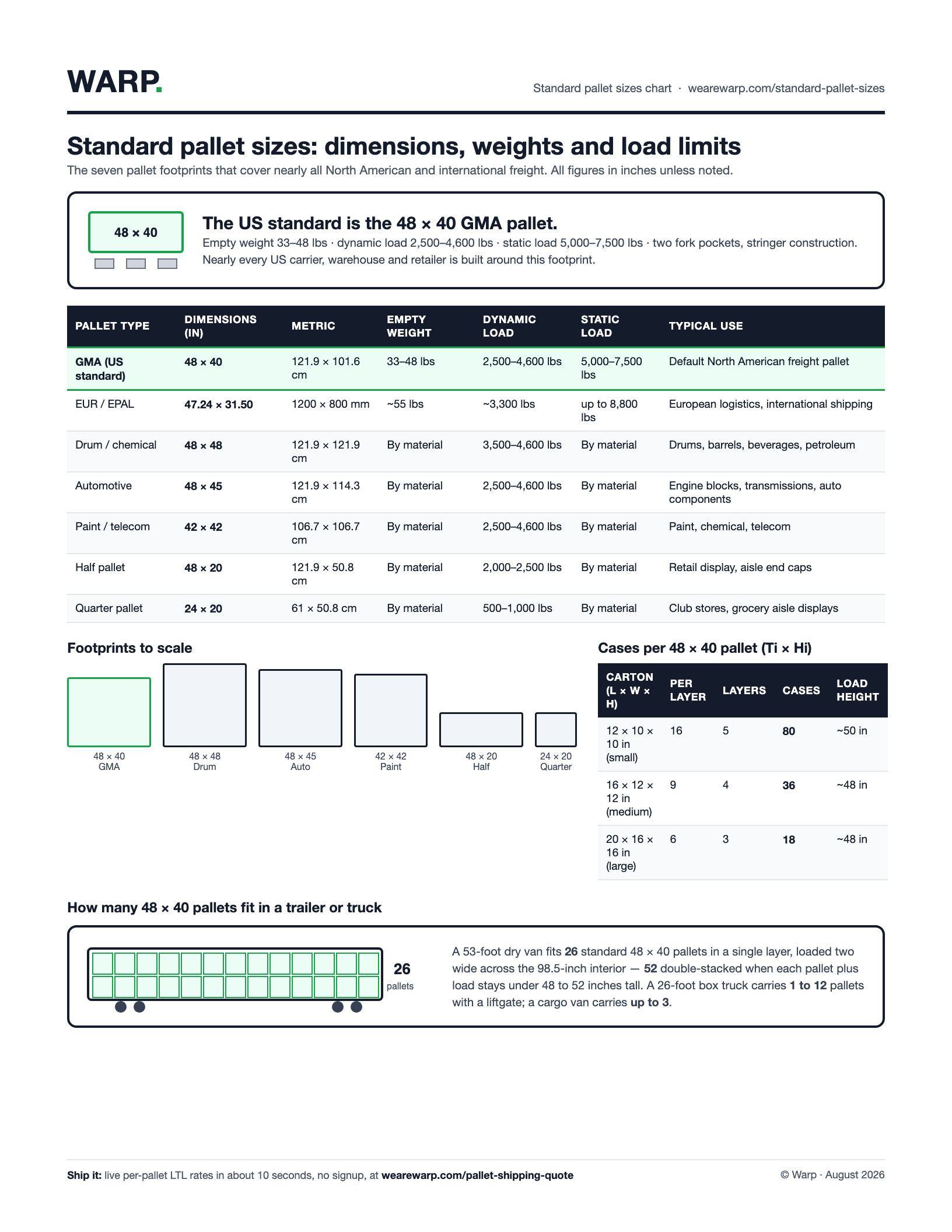
The one page chart, print ready
The standard pallet size: 48 x 40 inches
The standard pallet size in the United States is 48 inches long by 40 inches wide.
This is the GMA pallet, named after the Grocery Manufacturers Association (now the Consumer Brands Association) that established it as the industry standard.
In metric terms, that is 121.9 cm by 101.6 cm. The standard height for an empty GMA pallet is 6 to 6.5 inches (15.2 to 16.5 cm).
The 48 x 40 pallet became the dominant size because it fits efficiently inside standard North American truck trailers.
A 53 foot dry van trailer has an interior width of approximately 98.5 inches, which means two 40 inch pallets fit side by side with a small gap for airflow.
The 48 inch depth lets pallets sit flush against each other down the length of the trailer without wasted space.
This size also aligns with standard warehouse racking. Selective pallet racking, the most common warehouse storage system in the US, is designed around the 48 x 40 footprint.
Conveyor systems, stretch wrappers, and automated storage and retrieval systems all assume this dimension as the default.
The GMA pallet accounts for roughly 35% of all new pallets produced annually in the United States.
Including pallets already in circulation, roughly 2 billion GMA pallets are in active use across North American supply chains at any given time.
If you ship domestically in the US and don't specify a pallet type, you are almost certainly using a 48 x 40 GMA pallet.
The standard GMA pallet is a four way entry pallet, meaning a forklift can pick it up from any of the four sides. This makes it easy to handle in tight warehouse aisles and during truck loading.
Most GMA pallets use a stringer or block design with top deck boards, bottom deck boards, and supporting stringers or blocks that create the fork entry openings.
All standard pallet sizes by type
While the 48 x 40 GMA pallet dominates US freight, several other standard sizes serve specific industries and international shipping. The table below compares all seven by weight and typical use; the full written breakdown of each follows.
| Pallet type | Dimensions (in) | Empty weight | Dynamic load | Static load | Typical industries / use |
|---|---|---|---|---|---|
| GMA (US standard) | 48 × 40 | 33–48 lbs | 2,500–4,600 lbs* | 5,000–7,500 lbs | Default North American freight; nearly every carrier, warehouse, and retailer |
| EUR / EPAL | 47.24 × 31.50 | ~55 lbs | ~3,300 lbs | up to 8,800 lbs | European logistics, international shipping |
| Half pallet | 48 × 20 | By material | 2,000–2,500 lbs | By material | Retail display, aisle end caps |
| Quarter pallet | 24 × 20 | By material | 500–1,000 lbs | By material | Club stores, grocery aisle displays |
| Drum / chemical | 48 × 48 | By material | 3,500–4,600 lbs | By material | Drums, barrels, beverages, petroleum |
| Paint / telecom | 42 × 42 | By material | 2,500–4,600 lbs | By material | Paint, chemical, telecom |
| Automotive | 48 × 45 | By material | 2,500–4,600 lbs | By material | Engine blocks, transmissions, auto components; some food distributors |
*Heavy-duty GMA pallets handle up to 5,500 lbs dynamic. Empty weight and static load for the specialty sizes depend on pallet material (wood, plastic, or metal), covered in the Pallet materials section below. Custom pallets are built to non-standard dimensions for machinery and oversized equipment; they cost more and can trigger carrier surcharges because they do not optimize standard trailer space.
Full written breakdown, type by type
The GMA pallet (48 x 40 inches) is the workhorse of North American freight. It weighs 33 to 48 pounds empty depending on wood type and construction. Maximum load capacity ranges from 2,500 to 4,600 pounds for standard duty and up to 5,500 pounds for heavy duty versions. Nearly every US carrier, warehouse, and retailer is designed to handle this size. Many GMA pallets in circulation are pooled rental pallets from providers like CHEP (the blue pallet) or PECO (red), which meet the same 48 x 40 spec and ship and rack exactly like an owned wood pallet.
The EUR pallet, also called the Euro pallet or EPAL pallet, measures 47.24 x 31.50 inches (1200 x 800 mm). It is the standard in Europe and widely used in international shipping. It weighs about 55 pounds empty and supports loads up to 3,300 pounds for dynamic use (in motion) and 8,800 pounds for static stacking. If you ship to or from Europe, you will encounter this size frequently.
The half pallet measures 48 x 20 inches, exactly half the width of a GMA pallet. It is used primarily in retail display and point of sale applications. Stores use half pallets for aisle end displays because they fit neatly in standard retail fixtures. Maximum load capacity is typically 2,000 to 2,500 pounds.
The quarter pallet measures 24 x 20 inches. Like the half pallet, it is designed for retail display. Quarter pallets are common in club stores and grocery aisles where floor space is limited. They hold 500 to 1,000 pounds.
The 48 x 48 inch pallet is used for drums, barrels, and large format products. The square footprint provides stability for round containers that would overhang a standard 48 x 40 pallet. Chemical, beverage, and petroleum industries rely on this size. Load capacity is similar to the GMA pallet at 3,500 to 4,600 pounds.
The 42 x 42 inch pallet is another square format used in the paint, chemical, and telecom industries. It fits certain product dimensions better than the 48 x 40 and stacks efficiently in specific racking configurations.
The 48 x 45 inch pallet is the automotive industry standard. It provides a slightly wider footprint for engine blocks, transmissions, and large automotive components. Some food distributors also use this size.
Custom pallets exist for oversized or non standard products. Machinery, large equipment, and industrial components may require pallets built to specific dimensions. Custom pallets cost more and can trigger carrier surcharges because they don't optimize standard trailer space.
How many boxes fit on a pallet: configurations and gaylords
Pallet dimensions give you the footprint. What you actually want before booking is how your cartons turn into pallets. Shippers describe this as a Ti-Hi pattern: Ti is the number of cartons in one layer (the tier), Hi is the number of layers high. Multiply them and you get cases per pallet — the number that sets your pallet count, and your freight rate.
Three common carton sizes, square-stacked on a 48 × 40 GMA deck with no overhang:
| Carton size (L × W × H) | Per layer (Ti) | Layers (Hi) | Cases per pallet | Load height |
|---|---|---|---|---|
| 12 × 10 × 10 in (small) | 16 | 5 | 80 | ~50 in |
| 16 × 12 × 12 in (medium) | 9 | 4 | 36 | ~48 in |
| 20 × 16 × 16 in (large) | 6 | 3 | 18 | ~48 in |
Counts assume column stacking with no overhang. Interlocked (brick) patterns trade a few cases per layer for stability. A pallet of 36 medium cartons at 30 lbs each runs about 1,080 lbs plus the pallet — well inside the ~2,500 lbs a single LTL position typically allows. To get your own number: count your cartons and divide by cases per pallet.
Shipping loose product? Use a gaylord
When product is loose, granular, or too irregular to box and stack — parts, recycling, returns, produce — a gaylord ships it as one unit. A gaylord, also called a bulk box, pallet box, or bulk bin, is a heavy corrugated container sized to the pallet, typically 48 × 40 × 36 inches and about 40 cubic feet. A single-wall gaylord carries roughly 300 lbs; a double-wall box around 800 lbs; a triple-wall box up to about 1,500 lbs. Because it sits on the same 48 × 40 footprint as a standard pallet, a gaylord bills as one pallet position in LTL — so a loose-product shipment quotes exactly like a palletized one.
Pallet dimensions and weight limits
Understanding pallet weight limits requires separating empty pallet weight from load capacity, and distinguishing between static load (pallet is stationary) and dynamic load (pallet is being moved by a forklift or pallet jack).
Wood pallets are the most common. A standard 48 x 40 hardwood GMA pallet weighs 40 to 48 pounds. Softwood versions weigh 33 to 40 pounds. Hardwood pallets are more durable but heavier.
Dynamic load capacity for a standard wood pallet is 2,500 to 4,600 pounds. Static load capacity is higher, typically 5,000 to 7,500 pounds, because the pallet is evenly supported on a flat surface.
Plastic pallets weigh 15 to 30 pounds for the same 48 x 40 size. They don't absorb moisture, won't splinter, and don't require ISPM 15 heat treatment for international shipping.
Dynamic load capacity ranges from 2,500 to 5,000 pounds depending on design. High density polyethylene (HDPE) and polypropylene (PP) are the most common materials.
Plastic pallets cost $15 to $70 each versus $7 to $25 for wood.
Metal pallets, usually aluminum or steel, weigh 30 to 75 pounds. They are used in controlled environments like pharmaceutical manufacturing, automotive assembly, and military logistics.
Dynamic load capacity for steel pallets reaches 5,000 to 6,000 pounds. Aluminum pallets handle 2,500 to 4,500 pounds. Metal pallets cost $100 to $250 each but last decades.
Pallet height matters for truck loading. The interior height of a standard 53 foot dry van trailer is approximately 108 to 110 inches.
For double stacking (two pallets on top of each other), each pallet plus its load should stay under 48 to 52 inches total.
That gives you roughly 6 inches for the pallet itself and 42 to 46 inches for the freight. Exceeding this means you can't double stack, which halves the number of pallets you can fit in a trailer.
Stacking limits also depend on freight durability. Fragile products may need shorter stacks regardless of available height.
Top caps, corner boards, and proper stretch wrapping protect freight when pallets are stacked.
Most LTL carriers limit pallet height to 72 to 96 inches including the pallet, but Warp prices per pallet based on actual dimensions so you know the exact cost before booking regardless of height.
How pallet size affects freight shipping cost
Pallet size directly impacts freight cost through three mechanisms: trailer capacity utilization, dimensional weight calculations, and carrier surcharges for non standard sizes.
Trailer capacity determines how many pallets you can ship in a single truck. A standard 53 foot dry van trailer holds 26 standard GMA pallets (48 x 40 inches) loaded in a single row, two pallets wide.
If you double stack, the trailer holds 52 pallets.
Turn the pallets 90 degrees (40 inch side facing the trailer wall) and you can fit 30 pallets in a single layer, though this leaves narrow gaps between rows. Oversize pallets reduce these numbers.
A 48 x 48 inch pallet reduces single layer capacity to 22 pallets because you can no longer fit two pallets side by side across the trailer width.
In LTL shipping, you pay per pallet position. If your pallet overhangs the standard 48 x 40 footprint, the carrier may charge you for two pallet positions instead of one.
A 60 x 48 inch pallet, for example, takes up more floor space than a standard pallet and prevents other freight from loading next to it. This effectively doubles the per pallet cost for that unit.
Dimensional weight factors into LTL pricing when the pallet is light relative to its size. Traditional LTL carriers calculate a minimum billable weight based on the cubic dimensions of the pallet.
If the actual weight is below the dimensional weight threshold, the carrier bills at the higher dimensional weight. This penalizes lightweight, bulky pallets.
Warp uses per pallet pricing based on pallet count, weight, and dimensions, so there are no dimensional weight surprises on the invoice.
Carrier surcharges for non standard pallets include overhang fees, oversize handling charges, and special equipment requirements.
If your pallet doesn't fit on a standard forklift or doesn't stack safely with other freight, the carrier charges accordingly.
These surcharges range from $25 to $150 per pallet depending on the carrier and the degree of non standard sizing.
The cost takeaway is straightforward: standard 48 x 40 pallets ship at the lowest per pallet cost because they maximize trailer capacity, fit standard handling equipment, and require no special accommodation.
Every deviation from this standard increases shipping cost per unit.
Why an oversize pallet bills twice · 53 ft trailer, top-down, to scale
Warp prices per pallet on your actual dimensions, so the cost is on the quote before you book.
Choosing the right pallet size for your freight
The right pallet size depends on four factors: your product dimensions, your destination's handling requirements, carrier restrictions, and warehouse racking compatibility.
Start with your product dimensions. The goal is to keep all freight within the pallet footprint with no overhang.
Overhanging freight gets damaged during transit because it protrudes past the pallet edge and contacts other freight, trailer walls, or handling equipment.
If your product dimensions slightly exceed 48 x 40 inches, you have two options: use a larger pallet (48 x 48 or custom) and accept the higher shipping cost, or redesign your packaging to fit within the standard footprint.
Receiver requirements matter more than most shippers realize. Major retailers like Walmart, Target, Costco, and Amazon have strict pallet specifications.
Amazon FBA requires 40 x 48 inch pallets (the same GMA standard but with the 40 inch side facing the truck door, also called "40 inch leading edge").
Some Amazon facilities also accept 48 x 40 inch pallets, but compliance varies by fulfillment center. Costco requires four way entry pallets. Most grocery retailers require GMA standard.
If your receiver specifies a pallet size, use it. Non compliant pallets get rejected at the dock.
Carrier restrictions set maximum dimensions for standard pricing. Most LTL carriers price based on standard 48 x 40 pallet positions.
Anything wider than 48 inches or deeper than 48 inches may trigger oversize charges.
Most carriers set a maximum weight of 2,500 to 3,000 pounds per pallet for LTL, though some handle up to 4,600 pounds at higher rates. Check your carrier's tariff before booking non standard sizes.
Warehouse racking compatibility is the fourth factor. If your freight goes into storage before final delivery, the pallet must fit the destination warehouse's racking system.
Standard selective racking accommodates 48 x 40 pallets with 3 to 4 inches of clearance on each side. Drive in racking, push back racking, and flow racking each have different clearance requirements.
Sending a 48 x 48 pallet to a warehouse designed for 48 x 40 pallets means the pallet won't fit in the rack bays, forcing manual handling or floor stacking.
When in doubt, default to the 48 x 40 GMA pallet. It is accepted by virtually every carrier, warehouse, and retailer in North America.
The only reasons to deviate are specific product requirements (drums needing 48 x 48), retail display (half or quarter pallets), international shipping (EUR pallets), or receiver mandates.
Pallet materials: wood vs plastic vs metal
Pallet material choice affects cost, weight, durability, compliance, and total cost of ownership. Here is how the three main materials compare.
Wood pallets are the most common, representing over 90% of pallets in US circulation. New wood pallets cost $7 to $25 each depending on construction quality.
Recycled and refurbished wood pallets cost $4 to $12. Wood is cheap, strong, and widely available.
The downside is variability: wood pallets splinter, absorb moisture, harbor insects, and degrade over time.
A wood pallet lasts 3 to 5 trips on average in a one way supply chain, or 15 to 20 cycles in a closed loop system with repairs.
ISPM 15 compliance is the critical factor for international shipping with wood pallets.
The International Standards for Phytosanitary Measures No. 15 requires all wood packaging materials (including pallets) to be heat treated or methyl bromide fumigated before crossing international borders.
The treatment kills insects and pathogens that could spread between countries.
Treated pallets carry a stamp with the IPPC logo, country code, producer number, and treatment type (HT for heat treated, MB for methyl bromide).
If you ship internationally on untreated wood pallets, your shipment will be held at customs and possibly destroyed. This applies to pallets, crates, dunnage, and any other solid wood packaging.
Plastic pallets cost $15 to $70 each but last 10 to 15 years. They are lighter than wood (15 to 30 pounds vs 33 to 48 pounds), which reduces freight weight per shipment.
Plastic pallets don't require ISPM 15 treatment because they don't harbor pests, making them simpler for international shipping.
They are easier to clean and sanitize, which matters in food, pharmaceutical, and cleanroom environments. The trade off is upfront cost and the fact that plastic pallets can't be easily repaired.
A cracked wood pallet gets a new board nailed on. A cracked plastic pallet goes to recycling.
Metal pallets are the most durable and the most expensive at $100 to $250 each. Steel pallets are used in heavy manufacturing, military logistics, and environments where fire resistance matters.
Aluminum pallets are lighter and resistant to corrosion, making them suitable for food processing and pharmaceutical distribution.
Metal pallets last decades and can be loaded far heavier than wood or plastic.
The weight penalty (30 to 75 pounds empty) and high upfront cost limit their use to closed loop supply chains where the same pallets cycle repeatedly between fixed locations.
For most domestic freight shipping, wood pallets are the practical choice. They are cheap, widely accepted, and disposable if needed.
Plastic pallets make sense for high cycle closed loop systems, international shipping without ISPM 15 hassle, or environments requiring sanitation.
Metal pallets are justified only in heavy duty or long lifecycle applications where the durability premium pays back over thousands of cycles.
Frequently asked questions
What is the standard pallet size in the US?
The standard pallet size in the US is 48 x 40 inches (121.9 x 101.6 cm). This is the GMA pallet, established by the Grocery Manufacturers Association.
It accounts for approximately 35% of new pallet production and roughly 2 billion pallets in active circulation.
What are the dimensions of a standard pallet in inches?
A standard GMA pallet measures 48 inches long by 40 inches wide by 6 to 6.5 inches tall. The 48 x 40 footprint is the default size for US truck trailers, warehouse racking, and carrier pricing.
Two pallets fit side by side across the 98.5 inch interior width of a 53 foot dry van.
How much does a standard pallet weigh?
A standard 48 x 40 wood pallet weighs 33 to 48 pounds empty depending on whether it is softwood or hardwood construction. Plastic pallets of the same size weigh 15 to 30 pounds.
Metal pallets weigh 30 to 75 pounds.
How many pallets fit in a 53-foot trailer?
A 53 foot dry van trailer fits 26 standard GMA pallets (48 x 40 inches) in a single layer loaded two wide.
Double stacked, the trailer holds 52 pallets if each pallet plus load stays under 48 to 52 inches tall. Turning pallets 90 degrees allows 30 per layer but with tighter spacing.
What is a GMA pallet?
GMA stands for Grocery Manufacturers Association, now the Consumer Brands Association. The GMA pallet is the 48 x 40 inch standard pallet used across North American supply chains.
It is a four way entry pallet, meaning forklifts can access it from all four sides.
What is the difference between a standard pallet and a Euro pallet?
The standard US pallet (GMA) is 48 x 40 inches. The Euro pallet (EUR/EPAL) is 47.24 x 31.50 inches (1200 x 800 mm). Euro pallets are slightly smaller and are the standard in European logistics.
Euro pallets weigh about 55 pounds and support 3,300 pounds dynamic load. The different dimensions mean they don't optimize the same trailer and racking configurations.
What is the maximum weight for a standard pallet?
Standard 48 x 40 wood pallets support 2,500 to 4,600 pounds dynamic load (while being moved) and 5,000 to 7,500 pounds static load (while stationary).
Heavy duty pallets handle up to 5,500 pounds dynamic. Most LTL carriers cap individual pallet weight at 2,500 to 3,000 pounds for standard pricing.
Does pallet size affect LTL shipping cost?
Yes. LTL carriers price per pallet position based on the standard 48 x 40 footprint. Oversize pallets that exceed this footprint may be billed as two positions, doubling the cost.
Non standard sizes can also trigger surcharges for special handling. Standard GMA pallets ship at the lowest per pallet rate.
What pallet size do I need for Amazon FBA?
Amazon FBA requires 40 x 48 inch pallets (GMA standard with the 40 inch side as the leading edge). Some facilities also accept 48 x 40 orientation.
Maximum pallet height including the pallet is 72 inches for most FBA warehouses. Four way entry pallets are required. Check the specific fulfillment center's requirements before shipping.
Are there standard pallet height limits for shipping?
Most LTL carriers limit pallet height to 72 to 96 inches including the pallet itself. For double stacking in a 53 foot trailer, each pallet plus load should stay under 48 to 52 inches.
Warp prices per pallet based on actual dimensions, so you know the exact cost before booking regardless of height.
How many boxes fit on a standard pallet?
It depends on your carton size and stack height.
On a 48 x 40 GMA pallet, square-stacked with no overhang: 12 x 10 x 10 in cartons fit about 16 per layer and 80 to a pallet five layers high; 16 x 12 x 12 in cartons fit 9 per layer and 36 per pallet; 20 x 16 x 16 in cartons fit 6 per layer and 18 per pallet.
To estimate your own pallet count, find your cases per layer, multiply by the number of layers, then divide your total cartons by that number.
What is a gaylord box?
A gaylord is a large corrugated bulk container sized to a pallet footprint, typically 48 x 40 x 36 inches and about 40 cubic feet.
Also called a bulk box, pallet box, or bulk bin, it ships loose, granular, or irregular product as a single unit instead of stacked cartons.
Single-wall gaylords hold roughly 300 pounds, double-wall around 800 pounds, and triple-wall up to about 1,500 pounds.
A gaylord occupies one 48 x 40 pallet position, so it bills like a standard pallet in LTL.
What is a Ti-Hi pallet pattern?
Ti-Hi describes how cartons stack on a pallet. Ti (tier) is the number of cartons in a single layer; Hi is the number of layers high. Cases per pallet equals Ti multiplied by Hi.
For example, a carton that fits 9 per layer stacked 4 layers high is a 9 by 4 Ti-Hi, or 36 cases per pallet. Shippers use Ti-Hi to plan pallet counts and trailer space.
What is a CHEP pallet?
CHEP is a pallet pooling company that rents standardized blue 48 x 40 inch block pallets, the same GMA footprint used across North American freight.
Shippers rent CHEP pallets, use them for a shipment, and return them to the pool instead of buying and disposing of their own. PECO runs a similar pool with red pallets.
Pooled pallets meet GMA dimensions, so they ship and rack exactly like a standard wood pallet.
About the Warp freight network
More about the Warp freight network
Warp is a technology-driven freight network that combines cargo van, box truck, LTL, and FTL capacity under one operating system. Shippers get instant rates, real-time tracking, and access to 70+ cross-dock facilities and 14,000+ cargo vans and box trucks — with 80%+ US LTL zip-to-zip coverage and nationwide FTL, box truck, and cargo van.
The network is supported by 24,000+ vetted FTL carriers.
Unlike traditional brokers, Warp uses AI to match the right vehicle to every load based on weight, dimensions, urgency, and cost targets. Cross-dock operations reduce transit time by eliminating unnecessary terminal transfers.
Pool distribution and zone-skipping programs help enterprise shippers lower per-unit delivery costs while maintaining tight appointment windows.
Self-serve shippers can quote, compare, and book freight online in under two minutes. Enterprise accounts get dedicated capacity planning, committed rate programs, and a named operations team. Every shipment includes scan-level visibility from pickup through final delivery.
Warp operates across the contiguous United States with regional density in the Southeast, Texas, Midwest, and Northeast corridors, and West Coast and Southwest coverage from Los Angeles, Seattle and Phoenix.
Warp operates 70+ cross-dock facilities across the US, with named markets including Chicago, Atlanta, Houston, New York, Savannah, Orlando, Charlotte, Indianapolis, Columbus, Denver, New Orleans, Milwaukee, Dallas-Fort Worth, Nashville, Phoenix, Tampa Bay, Seattle, Los Angeles. They support faster transfers and fewer touches on recurring lanes.
Freight modes and vehicle types
| Mode | Max payload | Max cube | Best for |
|---|---|---|---|
| Cargo van | 3,500 lbs | 400 cu ft | Time-sensitive, last-mile, light pallets |
| Box truck | 10,000 lbs | 1,500 cu ft | Regional distribution, no dock required |
| LTL | Per-pallet | Shared trailer | Lower per-pallet cost via cross-dock routing |
| Dry van / FTL | 42,000+ lbs | Full 53-ft trailer | High-volume lanes, recurring programs |
Cargo vans handle loads up to 3,500 pounds and 400 cubic feet, ideal for time-sensitive deliveries, last-mile retail replenishment, and lightweight palletized freight.
Box trucks carry up to 10,000 pounds and 1,500 cubic feet, fitting most regional distribution and store delivery needs without requiring a loading dock.
Dry vans and full truckloads move 42,000+ pounds for high-volume lanes and recurring programs. LTL shipments share trailer space on optimized routes through Warp cross-docks, reducing per-pallet cost by consolidating multiple shippers on the same vehicle.
Warp does not default every shipment to a 53-foot trailer. The AI engine evaluates load weight, cube, delivery window, and cost to recommend the right vehicle. Shippers see all available mode options with live pricing in one comparison screen before booking.
Cross-dock operations
Cross-docking at Warp facilities eliminates warehouse storage. Inbound freight is sorted and transferred directly to outbound vehicles, typically within hours.
This reduces dwell time, lowers damage risk, and compresses delivery windows. Warp cross-docks support pallet-in, pallet-out operations with scan-level tracking at every handoff point.
- Atlanta — Southeast retail flow
- Chicago — Midwest manufacturing and replenishment
- Houston — Texas industrial distribution
- New York — dense Northeast delivery
Facility locations are selected for corridor density: Atlanta handles Southeast retail flow, Chicago serves Midwest manufacturing and replenishment, Houston covers Texas industrial distribution, and New York supports dense Northeast delivery. Each facility operates on appointment-based scheduling to prevent congestion and maintain throughput consistency.
Enterprise freight programs
Enterprise shippers get committed rate programs, dedicated account management, and custom SLA design. Warp builds lane-by-lane rate structures that account for volume commitments, seasonal variation, and mode flexibility. Operations teams monitor shipment execution daily and intervene proactively when exceptions occur.
Self-serve freight quoting
Shippers enter origin and destination, load details, and delivery requirements to see live rates across all available modes. Quotes include estimated transit time, vehicle type, and total cost.
Booking takes one click. After booking, shippers track every shipment with real-time GPS location, milestone updates, and proof of delivery documentation.
Industries and use cases
Retail shippers use Warp for store replenishment programs that deliver to hundreds of locations per week on tight appointment windows. Apparel brands use zone skipping to bypass regional parcel sortation and reduce per-unit delivery cost.
Food and beverage companies rely on time-definite delivery for perishable goods. Manufacturing operations use Warp for inbound vendor consolidation, combining multiple supplier shipments into fewer, fuller loads through cross-dock facilities.
Distribution companies use pool distribution to serve multiple delivery points from a single origin, splitting full truckloads at cross-docks into smaller last-mile vehicles.
Urgent freight recovery covers emergency capacity needs when primary carriers fail or demand spikes unexpectedly. Middle-mile optimization reduces cost and transit time on the longest segment of multi-leg shipments.
Know your pallet specs. Ship with confidence.
Get per pallet rates in seconds. Warp prices every pallet by count, weight, and dimensions with no surprises on the invoice.
All-inclusive per-pallet pricing. All-inclusive at booking. No hidden fees.
Performance figures are computed from Warp network data. See our methodology.
By Troy Lester