
3PL RFP template for brands: 8 sections, 12 bidder questions, a scoring rubric
The Warp 3PL RFP template is a working RFP for buying fulfillment, as a free PDF and as plain text you can paste into your own document. Fill the 8 sections with your numbers, send the 12 questions to 4 to 6 providers, and score the bids on all in cost per order, not on the storage rate. No email, no signup.
8 sections · 12 bidder questions · weighted rubric · bidder mix worksheet · reviewed September 2026
 8 pages, PDF
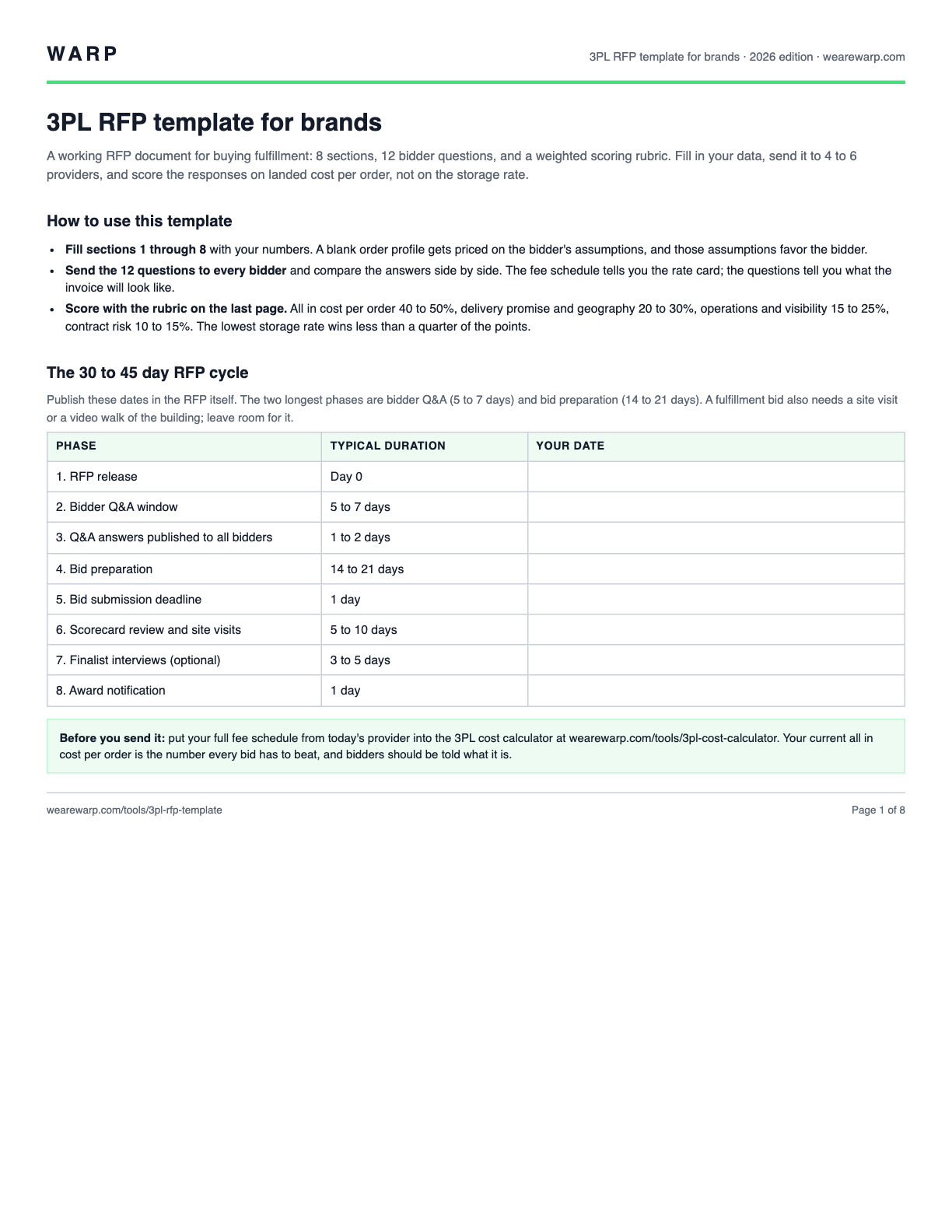
The 30 to 45 day RFP cycle
Publish these dates in the RFP itself. The two longest phases are bidder questions and bid preparation, and a fulfillment bid also needs a site visit or a video walk of the building.
| Phase | Typical duration | Earliest | Latest |
|---|---|---|---|
| 1. RFP release | Day 0 | Day 0 | Day 0 |
| 2. Bidder Q&A window | 5 to 7 days | Day 5 | Day 7 |
| 3. Q&A answers published to all bidders | 1 to 2 days | Day 6 | Day 9 |
| 4. Bid preparation | 14 to 21 days | Day 20 | Day 30 |
| 5. Bid submission deadline | 1 day | Day 21 | Day 31 |
| 6. Scorecard review and site visits | 5 to 10 days | Day 26 | Day 41 |
| 7. Finalist interviews (optional) | 3 to 5 days | Day 29 | Day 46 |
| 8. Award notification | 1 day | Day 30 | Day 47 |
Award lands between day 30 and day 47 after release. Publish the dates in the RFP itself; the two longest phases are bidder questions and bid preparation.
Before you send it, put the fee schedule from today's provider into the 3PL cost calculator. Your current all in cost per order is the number every bid has to beat.
The 8 sections every 3PL RFP needs, filled in here
Type your answers into the fields and take the finished RFP out as a PDF, a Word file or Markdown, or copy any section. A blank order profile gets priced on the bidder's assumptions, and those assumptions favor the bidder.
0 of 35 fields filled. Nothing leaves your browser.
Section 1. Company background and order profile
Purpose: Tell bidders what they are pricing. Orders per month, units per order and the DTC versus wholesale split drive every fee on the schedule.
Section 2. Inventory and SKU profile
Purpose: Storage and pick pricing depend on what sits on the shelf. Give bidders the shape of the catalog, not just the count.
Section 3. Receiving and inbound freight
Purpose: The freight into the building is a line most RFPs leave to the bidder, and it is where brokered markups hide. State who owns it and how it is priced.
Section 4. Storage and billing model required
Purpose: Force every bid onto one billing shape so you can compare it. Ask for pallet day or pallet month pricing with any minimums stated in dollars.
Section 5. Pick, pack and outbound
Purpose: The per order fees. Require a first pick, additional unit pick, packaging, and insert or kitting fees stated separately so the schedule can be modeled.
Section 6. Delivery promise and geography
Purpose: Where your customers are decides which building wins. Give bidders the order map and ask what promise each location can keep.
Section 7. Technology, reporting and visibility
Purpose: What you need to see, and how. Separate what you require from what would be nice.
Section 8. Contract terms and exit
Purpose: The terms that decide whether a bad month or a bad provider is survivable.
Take it with you
The PDF, Word and Markdown files carry your answers, the twelve bidder questions, the rubric and the bidder mix. The Word file opens in Word, Pages and Google Docs for editing.
The template in use
The RFP builder in use: the example filled in, the scoring sheet ranking three bidders, and the date planner.
The 12 bidder questions that predict the invoice
Ask every bidder the same twelve, in writing, and compare the answers side by side. The fee schedule tells you the rate card; these tell you what arrives on the bill.
Who runs the freight into and out of your building, and is it priced on the same quote as storage?
Brokered inbound and outbound freight is the biggest line most 3PL bids leave out. A provider that owns the trucks can put it on one per pallet number.
State every fee that is not on the rate card: accessorials, surcharges, rebills, reclassifications.
The difference between the quote and the invoice lives here.
What is your storage billing unit, and what is the minimum monthly charge in dollars?
Monthly minimums are a lease by another name. Pallet day billing with no minimum stay is the honest comparison point.
Which of your buildings would hold our inventory, and what delivery promise can each keep for our top 10 metros?
A same day or next day promise is a distance from a building, not a slogan. Ask for the radius.
What is your dock to stock time for a standard inbound pallet, and how is receipt confirmed?
Scanned, timestamped and photographed at receipt is checkable. "Same day receiving" is not.
Show a sample invoice for a month like ours, line by line.
The only document that cannot hide a fee.
How are exceptions reported: damage, shorts, mispicks, and with what evidence?
Photos attached and tracked to resolution, or an email a week later.
Can we see the storage bill before it posts, by SKU and by day?
Visibility that arrives after the invoice is not visibility.
What happens to our rate in a slow month, and in a peak month?
Minimums and peak surcharges both decide the true annual cost.
Can DTC parcels and wholesale pallets ship from the same inventory, and on whose trucks?
Two programs at two providers is two invoices and two margins.
What are the exit terms: notice period, inventory release fee, and data export?
The cost of leaving is part of the cost of joining.
Give three references shipping a profile like ours for at least a year, with the invoice date range we can ask about.
A reference that can talk about invoices beats a reference that can talk about onboarding.
Weighted evaluation rubric
Score each bid 1 to 5 on every criterion, multiply by the weight, and sum. Put every bidder's all in cost per order for a modeled month on the same line before you score anything else.
| Criterion | Weight | What a 5 looks like |
|---|---|---|
| All in cost per order, modeled month | 40 to 50% | Lowest landed cost with freight and fees included, quote equals invoice |
| Delivery promise and geography | 20 to 30% | Buildings inside your top metros; a stated same day or next day radius |
| Operations and visibility | 15 to 25% | Scanned and photographed receipt, exceptions with evidence, bill visible before it posts |
| Contract risk | 10 to 15% | No minimum stay, no platform fee, clean exit terms |
Score the bids here
Weights (must total 100)
| Bidder | All in cost per order | All in cost per order, modeled month | Delivery promise and geography | Operations and visibility | Contract risk | Weighted score | Rank | |
|---|---|---|---|---|---|---|---|---|
| $ | 3.00 / 5 | 1 | ||||||
| $ | 3.00 / 5 | 2 | ||||||
| $ | 3.00 / 5 | 3 |
Score each bid on a modeled month, not on the rate card. The all in cost per order column is the number the first criterion should be scored from; the calculator on this site produces it from any bidder's fee schedule.
Bidder mix worksheet
Invite at least one of each model so the bids expose each other's structure. A standalone 3PL prices the warehouse and brokers the freight; a marketplace 3PL prices the software and subcontracts the building; a carrier run fulfillment network prices the building and the trucks together.
| Model | What it usually does well | What to check |
|---|---|---|
| Standalone 3PL | Deep building operations, verticals | Who brokers the freight, and the markup on it |
| Marketplace or software led 3PL | Integrations, many locations on paper | Which building actually holds you; subcontractor SLAs |
| Carrier run fulfillment network | Freight in and out on one number, same day radius | Building count and fit for your metros |
| Marketplace fulfillment (FBA, WFS) | Channel specific speed badges | Fees by size tier, inventory limits, non channel orders |
Warp is the third row: 70+ warehouses inside its own freight network, anchored by four fulfillment centers, with the pallets in and out on one per pallet number and same day delivery within 30 miles of each center. What that program looks like is on the outsourced fulfillment page.
3PL RFP template FAQ
What should a 3PL RFP include?
Warp's free 3PL RFP template structures this around eight sections: company background and order profile, inventory and SKU profile, receiving and inbound freight, the storage and billing model you require, pick, pack and outbound, the delivery promise and geography, technology and visibility, and contract terms and exit. It also carries twelve written questions every bidder answers the same way, plus a scoring rubric weighted toward all in cost per order rather than the storage rate. The whole template downloads as a PDF or plain text, with no email required.
Is this 3PL RFP template free to download?
Yes. The blank PDF downloads with no email and no signup, the builder on this page turns your answers into a personalized PDF, a Word file or Markdown, and the copy buttons put any section or the whole template on your clipboard as plain text.
Is there a 3PL evaluation template?
The last page is one: a weighted rubric with four criteria (all in cost per order at 40 to 50%, delivery promise and geography at 20 to 30%, operations and visibility at 15 to 25%, contract risk at 10 to 15%), what a 5 looks like on each, and a column per bidder. Score every bid on a modeled month, not on the rate card.
How is a 3PL RFP different from a freight RFP?
A freight RFP buys lanes: rates by mode, accessorial policy, capacity commitments. A 3PL RFP buys a building and the labor in it: receiving, storage, picks, packaging, outbound and returns, with the freight around the building as one of the lines. Warp publishes both templates; the freight one lives at the freight RFP template page.
What is a 3PL pricing template?
The fee schedule every bidder should be made to fill in the same way: receiving per pallet, storage per pallet per month with minimums in dollars, first pick and additional unit pick, packaging, postage, returns, account and software fees, and inbound freight per pallet. Section 4 and 5 of this RFP ask for it, and the 3PL cost calculator on this site turns any bidder's schedule into all in cost per order.
How many 3PLs should I send an RFP to?
Four to six, with at least one of each model: a standalone 3PL, a marketplace or software led 3PL, a carrier run fulfillment network, and, if you sell on it, marketplace fulfillment. Different models expose each other's structure; a standalone 3PL prices the warehouse and brokers the freight, a carrier run network prices both together.
Which questions predict what the invoice will look like?
Who runs the freight into and out of the building and whether it is on the same quote as storage; every fee that is not on the rate card; the storage billing unit and the minimum in dollars; a sample invoice for a month like yours; and the exit terms. The other seven questions in the template cover delivery promise by metro, receipt confirmation, exceptions, billing visibility, slow and peak months, DTC and wholesale from one inventory, and references who can talk about invoices.
Draft your proposal, then book the call
- TodayA 30 minute call. You tell us what you store and where your orders land.
- This weekWarp answers all twelve bidder questions with a sample invoice for a month like yours, and a placement plan across the four fulfillment centers.
- First inboundYour pallets arrive on Warp trucks, scanned and photographed at receipt.
Four answers draft your proposal, all optional
Nothing here gates the call. The draft below is built from your answers and rides into the rep’s brief, so the call opens on your proposal, not on a blank page.
Fulfillment
30 min. You tell us what you store and where your orders go. We ask questions, you ask us back.
Fulfillment inside a freight network only pays off for some inventory profiles. We’d rather find out which of yours qualifies.
Who you'll meet





We’ll email your Google Meet link.
Put Warp in the bidder mix
Send the RFP, or skip a round: on a strategy call Warp maps your order history against four fulfillment centers, prices the freight in and out on its own network, and answers all twelve questions with a sample invoice.