
Set LTL and FTL margins.
Default 25% LTL, 20% FTL. Drag the slider; the markup is baked into every quote on your portal automatically.
For 3PLs and freight brokers who want to offer freight under their own name — without building a TMS or signing carrier contracts. Two ways to deploy: a one-line widget you embed on your existing site, or a hosted white-label shipper portal at your own domain. You set per-lane margins. Warp handles the 24,000+ carrier network, dispatch, tracking, and Stripe Connect payouts. Free to launch.
Free to launch · You keep 100% of your margin · Stripe Connect payouts · 24,000+ carriers · 5-min onboarding
Live all-inclusive rates
Paste a one-line script tag plus a <warp-quote> element into your site. The Lit-based web component renders an instant LTL and FTL quote form, books inline via Stripe, and pays your margin out automatically. No backend integration required.
Warp's 3PL Partner Platform ships a hosted shipper portal at portal.warp3pl.com/your-slug plus an embeddable Lit-based widget. Per-portal brand color and logo. The widget is customizable via accent color, theme (light or dark), font, button style, and border radius. Warp branding...
Yes. The Warp 3PL Partner Platform ships a Lit-based web component at widget.warp3pl.com/warp-quote.js. Drop the module script tag plus a warp-quote element with your partner-key anywhere on your site — the widget captures UTMs, fires FB Pixel and Google Ads...
Set LTL and FTL margin percentages in the Margins page of partners.warp3pl.com. Per-lane overrides available for recurring corridors. Margin is baked into the all-in price your shipper sees; the spread pays out to your Stripe Connect account.
Warp 3PL Partner Platform. Connect your Stripe account during onboarding (~90 seconds). Every booking pays your margin to your Stripe Connect account on the platform's payout schedule. Standard Stripe fees apply to payouts, not Warp's wholesale freight cost.
Create a customer portal in the admin: set company name, slug, brand color, and logo. Your shippers sign in at portal.warp3pl.com/your-slug to quote, book, and track freight under your brand.
Warp 3PL Partner Platform is free to launch with no minimum volume, no seat licenses, and no per-call fees. A small 3PL can finish onboarding in five minutes and start selling freight the same day. Warp earns from the underlying...
A typical partner finishes onboarding (Welcome, Pick a setup, Configure, Launch) in under five minutes. Connecting Stripe Connect takes about 90 seconds. After that the hosted portal is live and the widget snippet is ready to paste.
Drop the Warp 3PL Partner Platform widget into your e-commerce checkout. The Lit-based web component renders LTL and FTL rates inline, accepts pickup and delivery details, and books via Stripe — all without leaving your checkout. Works on Shopify, WooCommerce...
Warp's embeddable freight quote widget works on any platform that accepts a script tag — Shopify, WooCommerce, BigCommerce, Magento, Webflow, and custom React or HTML sites. The widget is framework-agnostic and renders inline; no plugin install required. Set your margin...
Sign up at partners.warp3pl.com, pick the hosted portal setup, configure your brand and margin, and connect Stripe Connect. Your branded shipper portal is live the same day. No engineering, no TMS install, no carrier contracts. Your shippers see your brand...
Warp 3PL Partner Platform is free to launch with no minimum volume, no seat licenses, no per-call fees, and no upfront cost. Warp earns from the underlying freight (the wholesale margin); your stated margin stacks on top and goes entirely...






A live walkthrough of every screen a new partner sees, from sign-up to first dollar of margin. Every screenshot is from the production product at partners.warp3pl.com, captured today.
Set it once. Earn on every booking.
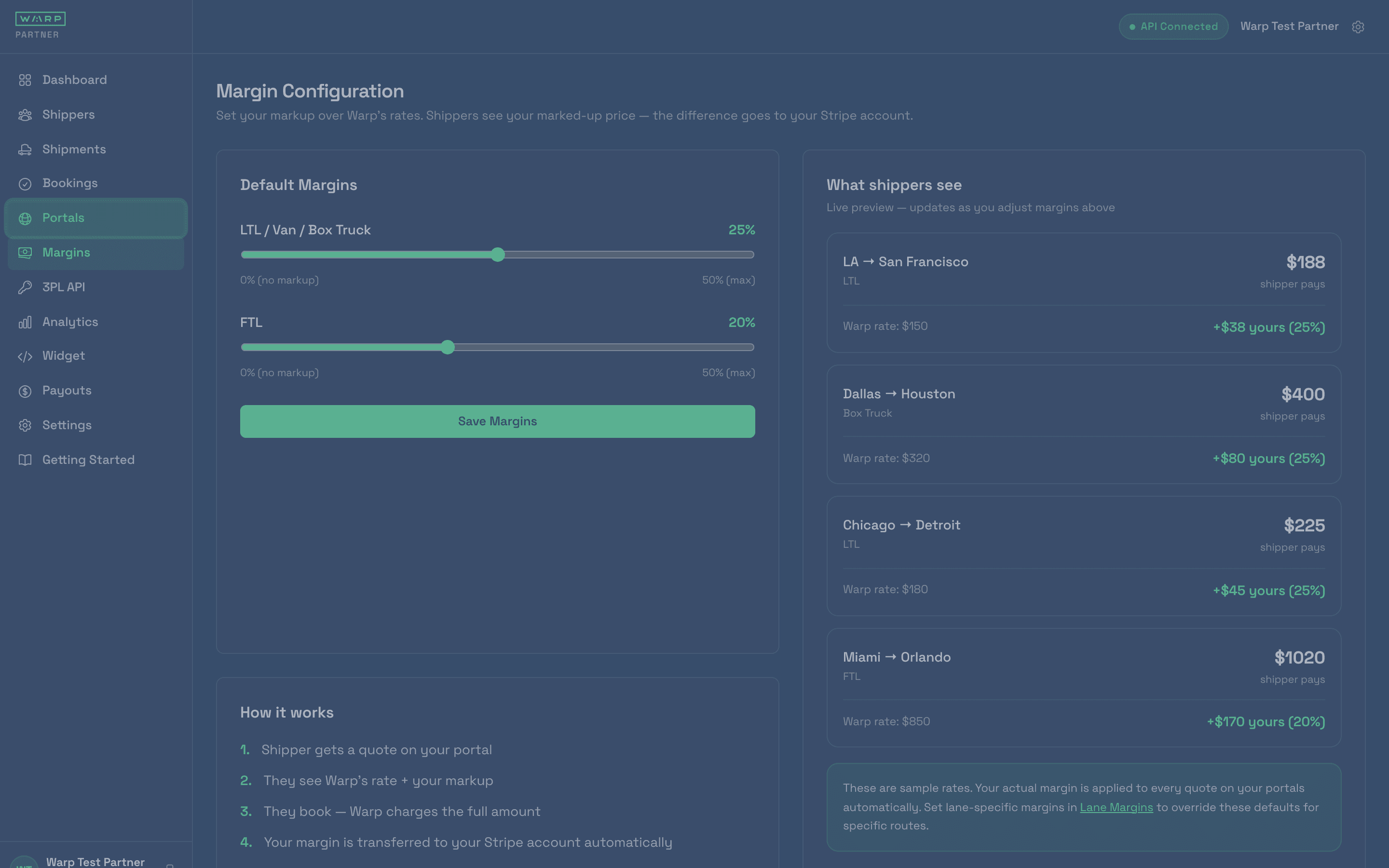
Default 25% LTL, 20% FTL. Drag the slider; the markup is baked into every quote on your portal automatically.
LA → San Francisco books at $188 with $38 yours. Miami → Orlando at $1,020 with $170 yours. The dashboard shows what shippers pay and what lands in your account.
For recurring lanes where competition is tight, override the global margin. Set a different markup per origin/destination pair without losing the defaults elsewhere.
Your name on every surface. Ours hidden.
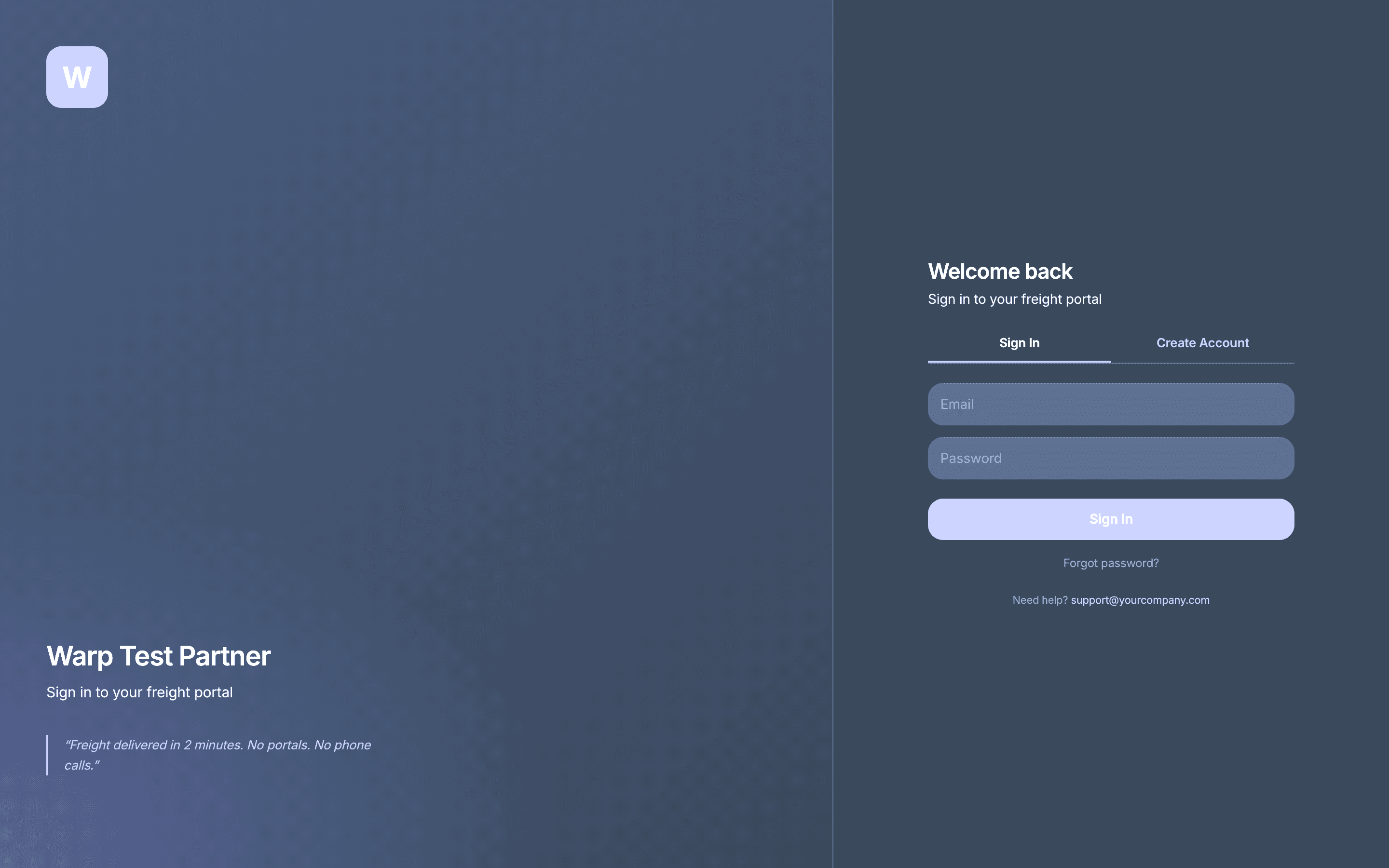
The login page, tracking page, email notifications, and invoices all carry your logo, your brand color, your tagline. The carrier label even overrides "Warp Technology" out of quote results.
Create as many customer portals as you have shippers — each with its own slug, primary brand color, and logo. All portals roll up under one partner account, one set of margins, one Stripe Connect payout.
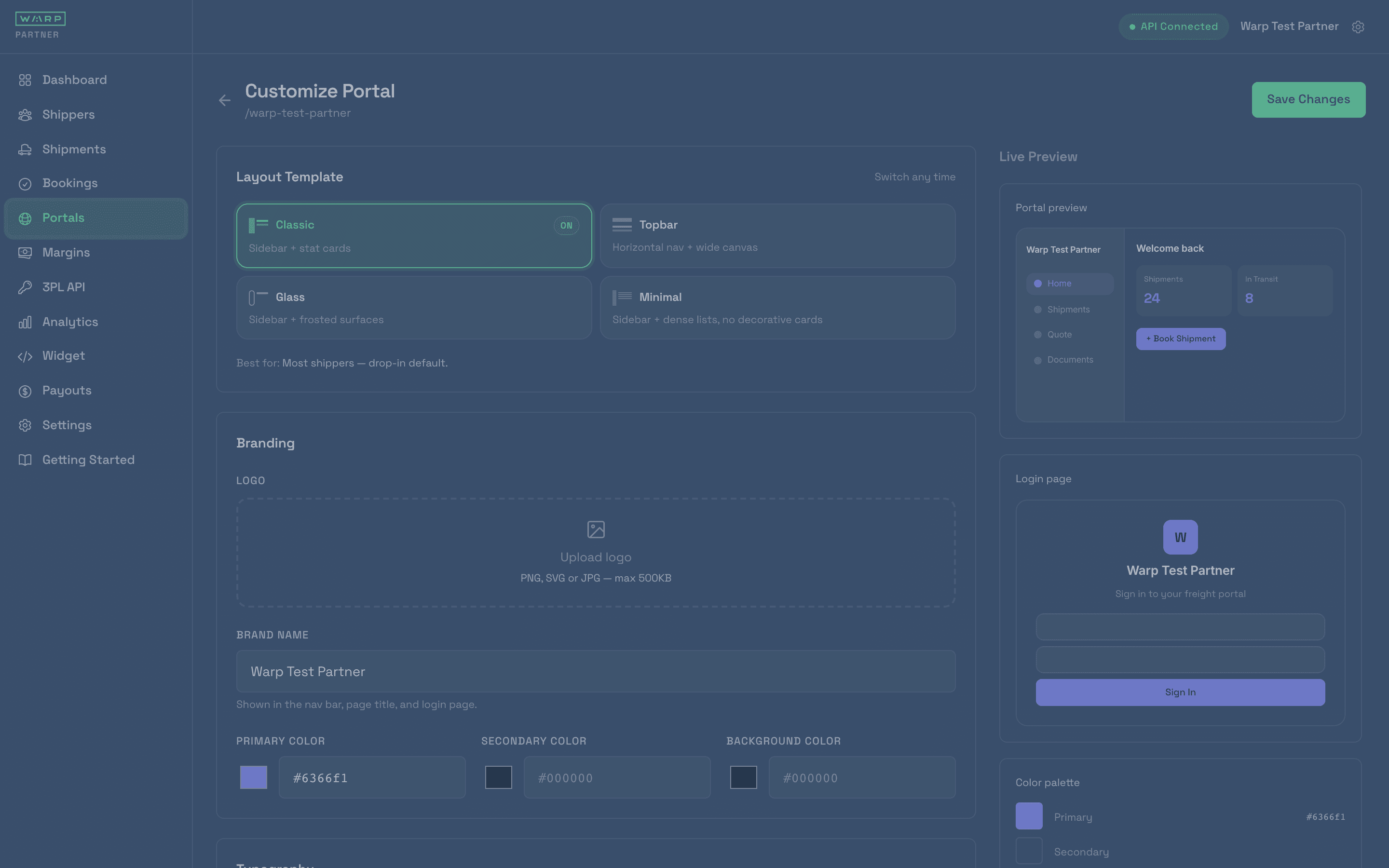
Set the company name, slug, primary brand color, and logo per portal in your admin. Light or dark theme. The same data, margins, and shippers stay identical underneath.
Stripe Connect pays you. No invoicing.
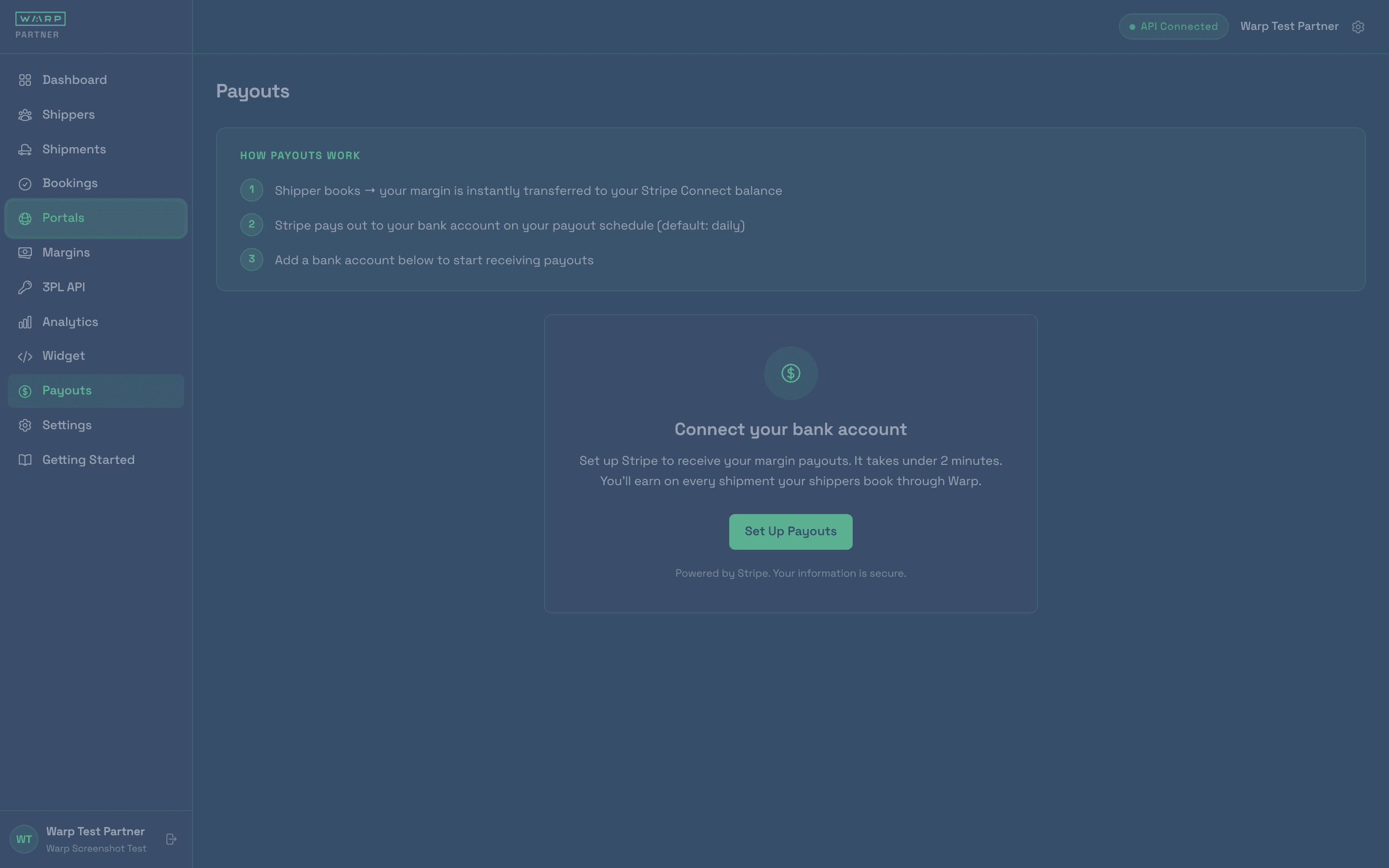
The second a shipper confirms checkout on your portal, your margin transfers to your Stripe Connect balance. No reconciliation, no spreadsheet, no chasing checks.
On your payout schedule — default daily — Stripe sweeps your balance to the bank account you connected. Standard Stripe fees apply to payouts only.
The Connect onboarding takes about a minute and a half. After that, the dashboard just shows how much you made and when it landed.
Two paths, same backend. A hosted portal at portal.warp3pl.com/your-slug — full sign-in, dashboard, shipment history, zero hosting. Or drop a freight-quote widget into the site you already run.
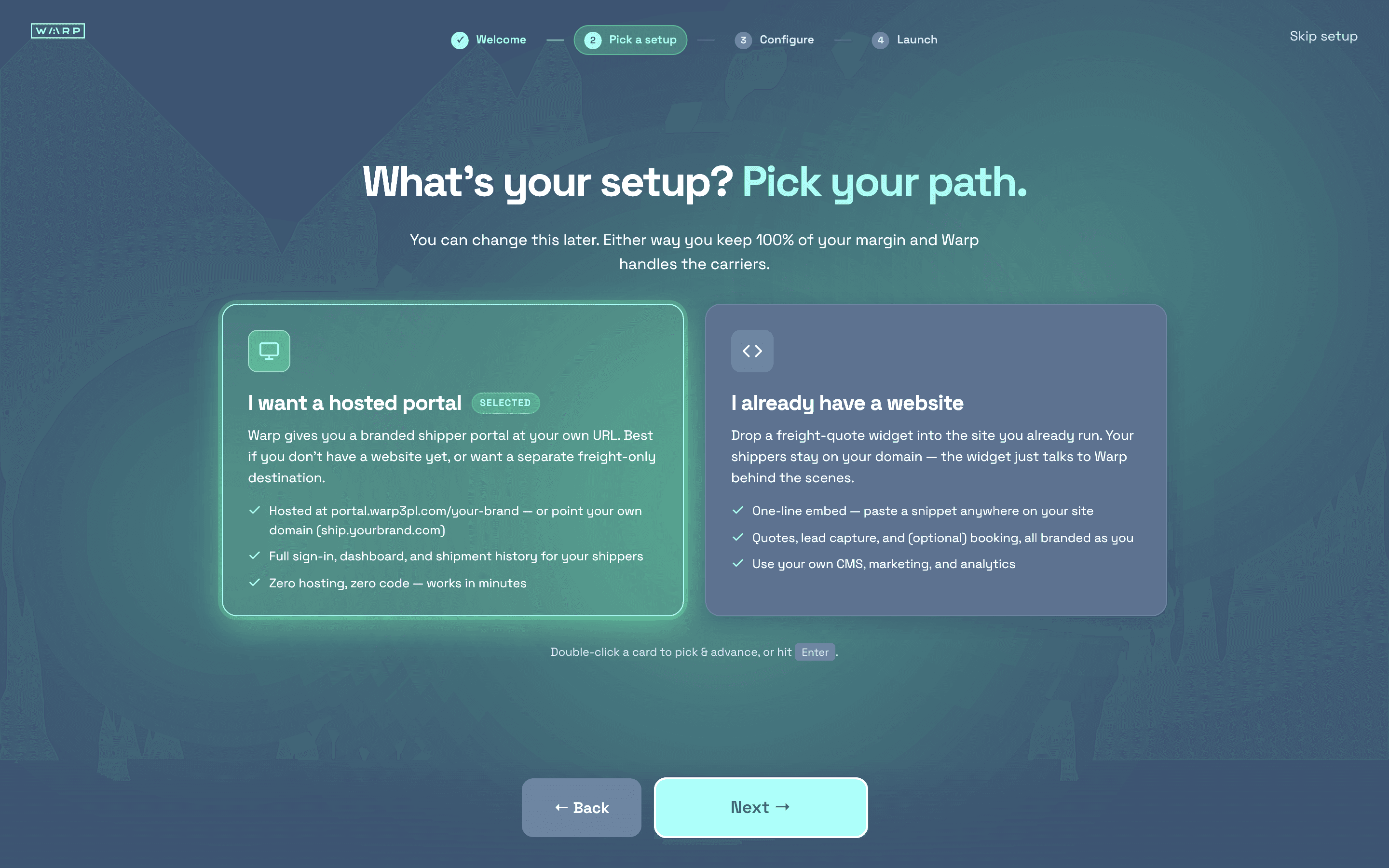
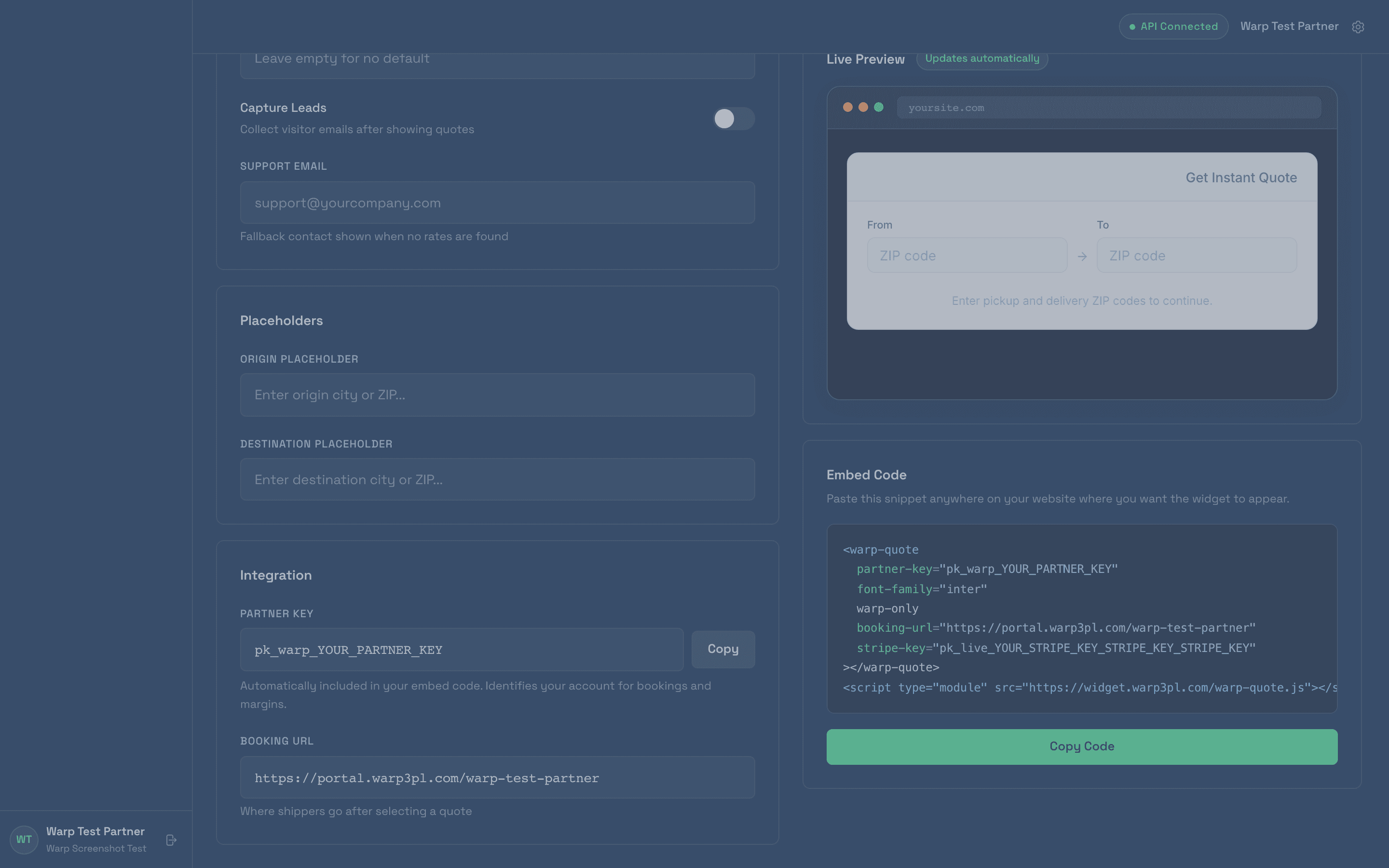
Brand color, layout, font, button style. Live preview as you edit. The widget loads from widget.warp3pl.com, captures UTMs, fires Facebook Pixel and Google Ads events, and books inline via Stripe — no backend integration required.
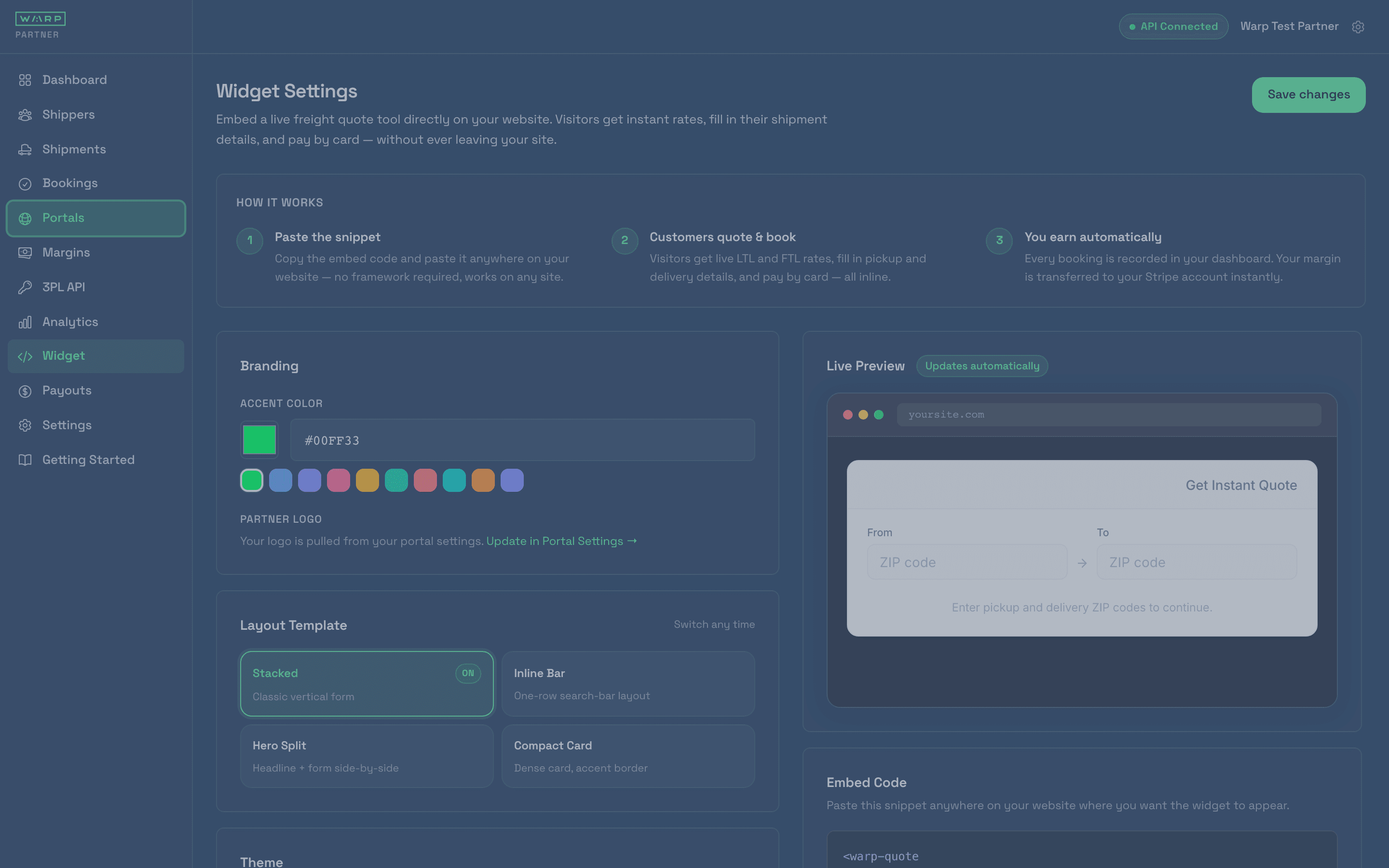
Brand color, theme (light or dark), font, button style, border radius — all tunable from the widget builder. One <script> tag, one <warp-quote> element, your freight quoting is live.
Logo upload, primary and secondary colors, fonts, custom CSS, welcome message, footer text, support email. Layout templates flip live so you can see the result before you publish.
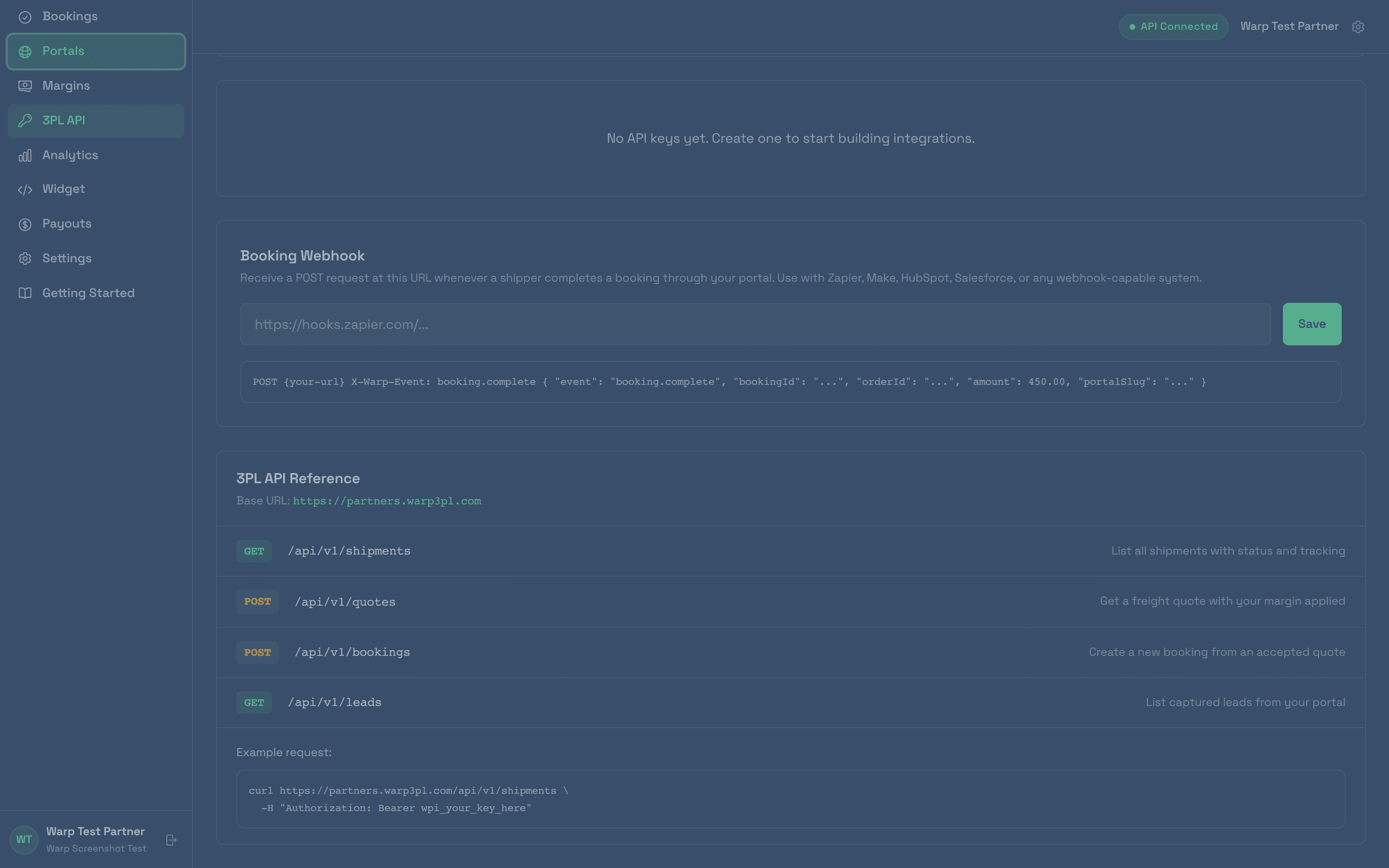
Every partner gets their own /v1/quotes, /v1/bookings, /v1/shipments, /v1/leads endpoints — under your brand, with your margin baked in. Hand the key to a shipper's engineering team.
What a new partner sees on signup — a live portal preview with sample bookings already showing the margin they'd earn. $178 (includes +$30 yours), $713 (+$93 yours), $2,340 this month.
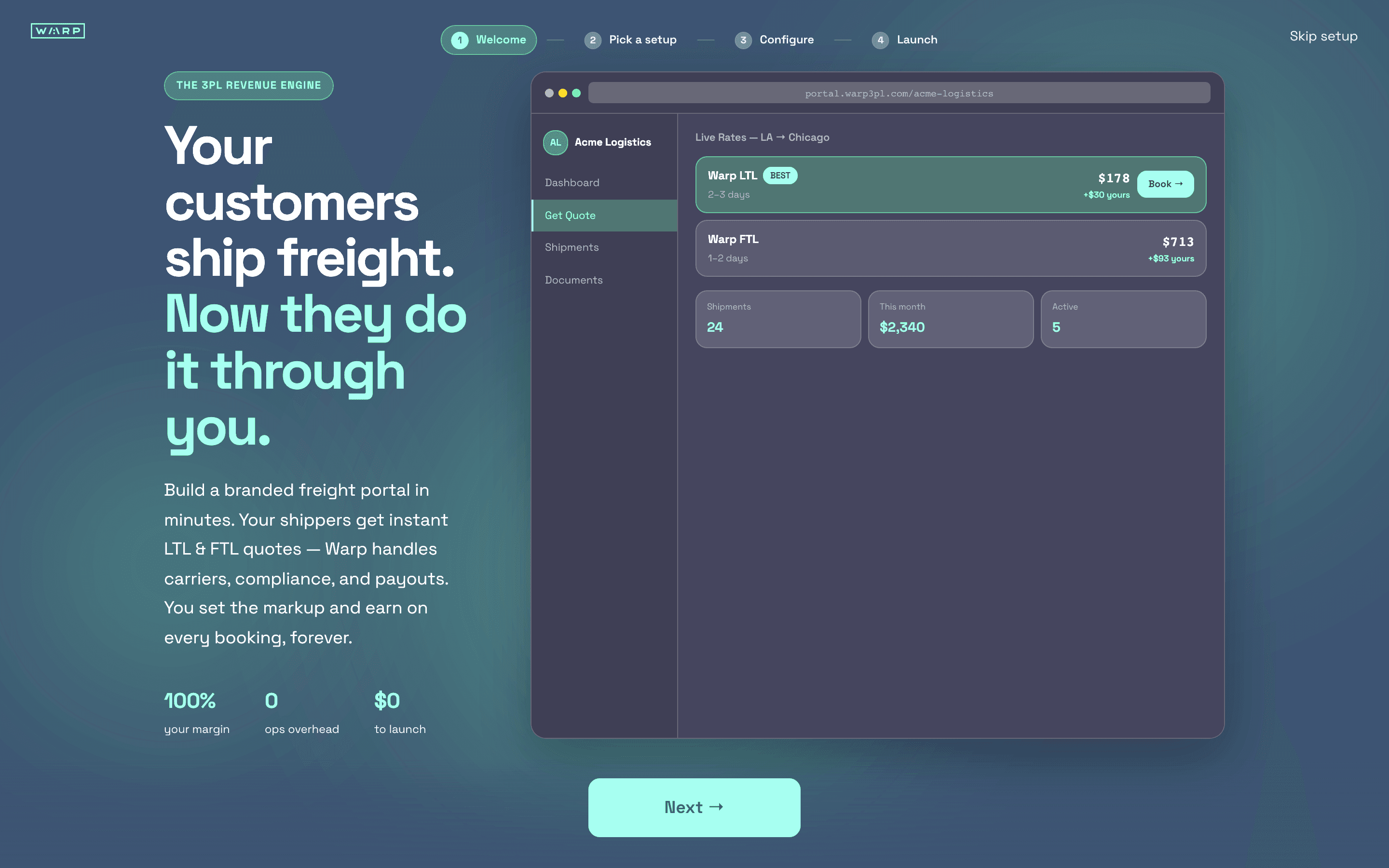
Sign up at partners.warp3pl.com. Pick a setup, set your margin, connect Stripe Connect. Your portal is live. The widget snippet is ready to paste. Your shippers can book today.
Sign up free at partners.warp3pl.com →Free to launch · No credit card · You keep 100% of your margin · Stripe Connect payouts
Pick one at onboarding. Run both at the same time if you want — the back-end is shared. Hosted portal: a complete branded shipper SaaS at partners.warp3pl.com/your-slug or your own domain.
Embed widget: a one-line script tag plus a <warp-quote> element you drop anywhere on your existing site.
Portal partners get the full self-service experience (sign-in, history, recurring shipments) under their own brand; widget partners keep shippers on their existing domain for SEO, analytics, and CRM continuity.
Both share the same bookings, shippers, margins, and 3PL API.
The shipper logs in to your branded portal and sees a dashboard with shipment stats, instant LTL and FTL quotes, multi-step checkout with pickup and delivery details, shipment tracking with GPS, document download (BOL, POD with photos), and booking history.
Per-portal customization in the admin: company name, slug, primary brand color, and logo. The shipper portal uses a glassmorphism design system with a light/dark theme toggle.
Paste two lines anywhere on your site.
The widget is a Lit-based <warp-quote> web component you configure via HTML attributes — partner-key, accent-color, theme (light or dark), background-color, partner-logo, font-family, border-radius, button-style, cta-text.
The widget captures UTM parameters (utm_source, utm_medium, utm_campaign, utm_content, utm_term, plus gclid and fbclid) from the host page URL, fires Facebook Pixel (fbq) and Google Ads (gtag) events, posts to your webhook-url on quote selection (fire-and-forget), and exposes lead capture via the leads-api attribute.
When stripe-key is set, checkout happens inline via Stripe Card Element — no redirect needed.
You set a margin percentage for LTL and FTL freight separately, with per-lane overrides for recurring corridors. That percentage bakes into the all-in price the shipper sees — they never see the split.
Margins update live for all new quotes and can be tuned any time in the Margins page.
More than the standard “portal + widget.” Every partner account ships with the surfaces below built in — no add-on tier, no per-feature pricing.
In-product support escalation routes shipper issues to your team first. Webhooks fire on quote selection so you can chain bookings into your CRM. UTM parameters flow end-to-end from widget click through to your bookings table for full attribution.
The dashboard at partners.warp3pl.com runs an analytics-style home — metric cards plus a setup wizard that walks new partners through margins, portal, Stripe payouts, widget embed, promos, lane pricing, and email automation. Recent-leads feed below.
Eighteen dedicated surfaces cover everything from per-corridor margin overrides to Falvey insurance configuration to the in-product email automation builder. Getting Started ships as an in-product playbook.
Every partner account ships with a standalone API surface they can hand to a shipper's engineering team.
One key fetches quotes, creates bookings, and pulls shipment data — all under your brand, with your margin baked in. Endpoints: /v1/quotes, /v1/bookings, /v1/shipments, /v1/leads.
The dashboard's Integrations page renders a live API reference with copy-pastable curl examples.
If your team wants to build a deeper TMS on top of Warp's raw freight API directly (multi-tenant rate cards, multi-stop FTL, full document workflows), the developer playbook is at /build-your-own-3pl-software.
Brokers under roughly $10M without a quoting product use the platform to stop emailing rate sheets.
Onboard, set your LTL and FTL margins, embed the widget on your existing site (or stand up the hosted portal at a subdomain), and you have a digital brokerage running the same day.
For brokers with an engineering team that wants to build a custom brokerage TMS on top of the underlying API, see /build-freight-broker-software for the deeper migration path.
When a shipper books through your portal or widget, Warp routes the load across a network of carriers, cross-dock facilities, and box trucks and cargo vans — every shipment with live GPS tracking, scan-in / scan-out events at every facility, proof-of-delivery photos, and electronic signature capture.
Warp handles carrier sourcing, compliance and insurance vetting, dispatch, chargebacks, and exception monitoring. Your team handles the relationship with your shipper.
Yes. The widget can be embedded on your marketing site while the portal lives at a dedicated subdomain. Both share the same bookings, shippers, margins, and 3PL API under one partner account.
No. Warp branding is suppressed across the portal and the widget.
The carrier label can also be overridden so quote results do not say "Warp Technology." Tracking pages, emails, and invoices all carry your brand.
LTL, FTL, cargo van, box truck, and multi-stop FTL. Mode availability on each lane depends on the underlying carrier network.
Via Stripe in the portal or the widget.
The widget supports inline Stripe Card Element checkout; the portal supports the full sign-in checkout flow with saved cards and Net-30 credit for qualifying shippers.
Partners do not touch payment processing.
On the widget, yes — they enter shipper and consignee contact info and pay via Stripe. On the hosted portal, they sign in.
Lead capture on the widget pulls a shipper email into the partner dashboard even if they do not end up booking.
Yes. Export CSV is available on the Dashboard and Bookings pages, honoring the current filter set (date range, portal, status, search).
Falvey Cargo Insurance is integrated as an optional add-on inside the shipper checkout. The shipper sees a toggle for "Add Falvey Cargo Insurance" with a live premium quote.
Not in V1. Partners that need rate-card or dedicated-carrier behavior should talk to Warp enterprise.
The hosted portal and widget cover the self-serve LTL and FTL case across the standard carrier network.
Warp is a technology-driven freight network that combines cargo van, box truck, LTL, and FTL capacity under one operating system. Shippers get instant rates, real-time tracking, and access to 50+ cross-dock facilities, 1,500+ active lanes, and 9,000+ cargo vans and box trucks nationwide.
The network is supported by 24,000+ vetted carrier partners.
Unlike traditional brokers, Warp uses AI to match the right vehicle to every load based on weight, dimensions, urgency, and cost targets. Cross-dock operations reduce transit time by eliminating unnecessary terminal transfers.
Pool distribution and zone-skipping programs help enterprise shippers lower per-unit delivery costs while maintaining tight appointment windows.
Self-serve shippers can quote, compare, and book freight online in under two minutes. Enterprise accounts get dedicated capacity planning, committed rate programs, and a named operations team. Every shipment includes scan-level visibility from pickup through final delivery.
Warp operates across the contiguous United States with regional density in the Southeast, Texas, Midwest, and Northeast corridors.
Cross-dock facilities in Atlanta, Chicago, Houston, New York, Savannah, Orlando, Charlotte, Indianapolis, Columbus, Denver, New Orleans, and Milwaukee support faster transfers and fewer touches on recurring lanes.
Cargo vans handle loads up to 3,500 pounds and 400 cubic feet, ideal for time-sensitive deliveries, last-mile retail replenishment, and lightweight palletized freight.
Box trucks carry up to 10,000 pounds and 1,500 cubic feet, fitting most regional distribution and store delivery needs without requiring a loading dock.
Dry vans and full truckloads move 42,000+ pounds for high-volume lanes and recurring programs. LTL shipments share trailer space on optimized routes through Warp cross-docks, reducing per-pallet cost by consolidating multiple shippers on the same vehicle.
Warp does not default every shipment to a 53-foot trailer. The AI engine evaluates load weight, cube, delivery window, and cost to recommend the right vehicle. Shippers see all available mode options with live pricing in one comparison screen before booking.
Cross-docking at Warp facilities eliminates warehouse storage. Inbound freight is sorted and transferred directly to outbound vehicles, typically within hours.
This reduces dwell time, lowers damage risk, and compresses delivery windows. Warp cross-docks support pallet-in, pallet-out operations with scan-level tracking at every handoff point.
Facility locations are selected for corridor density: Atlanta handles Southeast retail flow, Chicago serves Midwest manufacturing and replenishment, Houston covers Texas industrial distribution, and New York supports dense Northeast delivery. Each facility operates on appointment-based scheduling to prevent congestion and maintain throughput consistency.
Enterprise shippers get committed rate programs, dedicated account management, and custom SLA design. Warp builds lane-by-lane rate structures that account for volume commitments, seasonal variation, and mode flexibility. Operations teams monitor shipment execution daily and intervene proactively when exceptions occur.
The self-serve portal lets shippers enter origin and destination, load details, and delivery requirements to see live rates across all available modes. Quotes include estimated transit time, vehicle type, and total cost.
Booking takes one click. After booking, shippers track every shipment with real-time GPS location, milestone updates, and proof of delivery documentation.
Retail shippers use Warp for store replenishment programs that deliver to hundreds of locations per week on tight appointment windows. Apparel brands use zone skipping to bypass regional parcel sortation and reduce per-unit delivery cost.
Food and beverage companies rely on time-definite delivery for perishable goods. Manufacturing operations use Warp for inbound vendor consolidation, combining multiple supplier shipments into fewer, fuller loads through cross-dock facilities.
Distribution companies use pool distribution to serve multiple delivery points from a single origin, splitting full truckloads at cross-docks into smaller last-mile vehicles.
Urgent freight recovery covers emergency capacity needs when primary carriers fail or demand spikes unexpectedly. Middle-mile optimization reduces cost and transit time on the longest segment of multi-leg shipments.
Sign up at partners.warp3pl.com. Pick a setup (hosted portal or embeddable widget), configure your brand and margin, connect Stripe Connect, and launch. Free to use, no volume minimum, no seat licenses.
Free to launch · You keep 100% of your margin · Stripe Connect payouts · 24,000+ carriers · 5-min onboarding